







The landscape of U.S. real estate investment is shifting. According to the National Association of Realtors® (NAR) 2025 International Transactions in U.S. Residential Real Estate report released in late July 2026, foreign buyers are pulling back significantly from the American housing market.
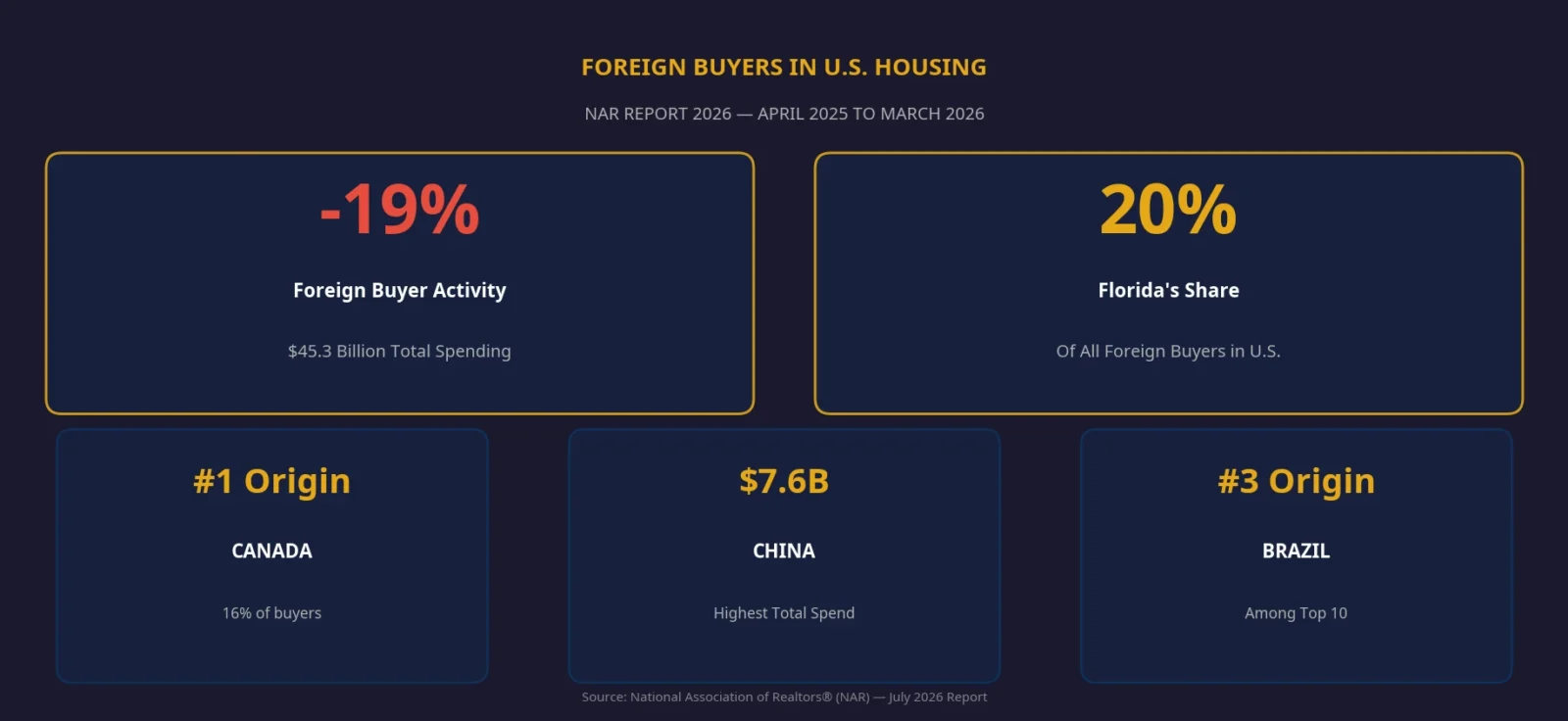
From April 2025 through March 2026, international buyers closed on 67,100 existing homes nationwide, down 14% year-over-year. This cohort invested $45.3 billion in U.S. homes, representing a decline of 19% — or $11 billion — from the previous 12-month period. This marks the second-lowest transaction level since 2009.
The Florida Exception
Despite this nationwide retreat, one state continues to command an outsized share of global demand: Florida. The Sunshine State secured 20% of all foreign buyers, maintaining its position as the undisputed number one destination for international wealth.
Within Florida’s international buyer pool, nearly half (48%) originate from Canada, while close to a third come from Latin America. This geographic concentration highlights the enduring appeal of South Florida as a safe haven, a tax-friendly jurisdiction, and a lifestyle capital for global citizens.
Who Is Buying (and Who Is Spending the Most)?
The demographic makeup of foreign buyers is evolving. Canada has reclaimed its spot as the top country of origin among foreign buyers, accounting for 16% of international transactions. Southern neighbor Mexico follows at 14%, while China — last year’s leader — settled for third place with 11%.
However, volume does not always equal value. While Chinese nationals dropped in the number of units sold, they spent the most of all groups, totaling $7.6 billion. This is because they continue to purchase significantly more expensive properties, averaging $1 million per purchase. Total spending by Chinese home shoppers fell sharply from $13.7 billion a year earlier.
India (9%) and the U.K. (4%) were the next largest countries of origin, with Italy, France, Brazil, Argentina, and Spain also making a meaningful mark.
Property Preferences and the “Hybrid” Model
The NAR study reveals distinct preferences among global cohorts. The majority (65%) of foreign buyers scooped up detached single-family homes. However, among international buyers residing overseas, 18% preferred condominiums.
In Miami, this translates to a strong preference for amenity-rich, waterfront condos among Canadian “snowbirds” and Latin American investors. Yet, a new “hybrid” model is emerging: condo-hotel properties. This hybrid model offers a real vacation home when owners want to use it, professionally managed the rest of the time, with none of the burden of being a traditional landlord.
Furthermore, 49% of all foreign buyers purchased property in the U.S. to use as a vacation home, rental, or both. Nearly 3 out of 4 Canadians use their U.S. real estate holdings strictly as vacation homes.
What This Means for South Florida
The 19% decline in foreign spending is driven by high prices, tight inventory, and shifting migration trends. However, the resilience of Florida’s luxury market proves that high-net-worth individuals still view South Florida as a premier destination.
For investors and international buyers navigating this shifting landscape, understanding these demographic and geographic trends is crucial for making informed decisions in 2026.
Looking to invest in South Florida from abroad? contact Faccin Investments for expert guidance on navigating the U.S. market as an international buyer.