







Miami is attracting global attention again, but the smartest foreign buyer in 2026 is not chasing a headline. They are using the moment to choose a property that works for use, income, liquidity and long-term ownership.
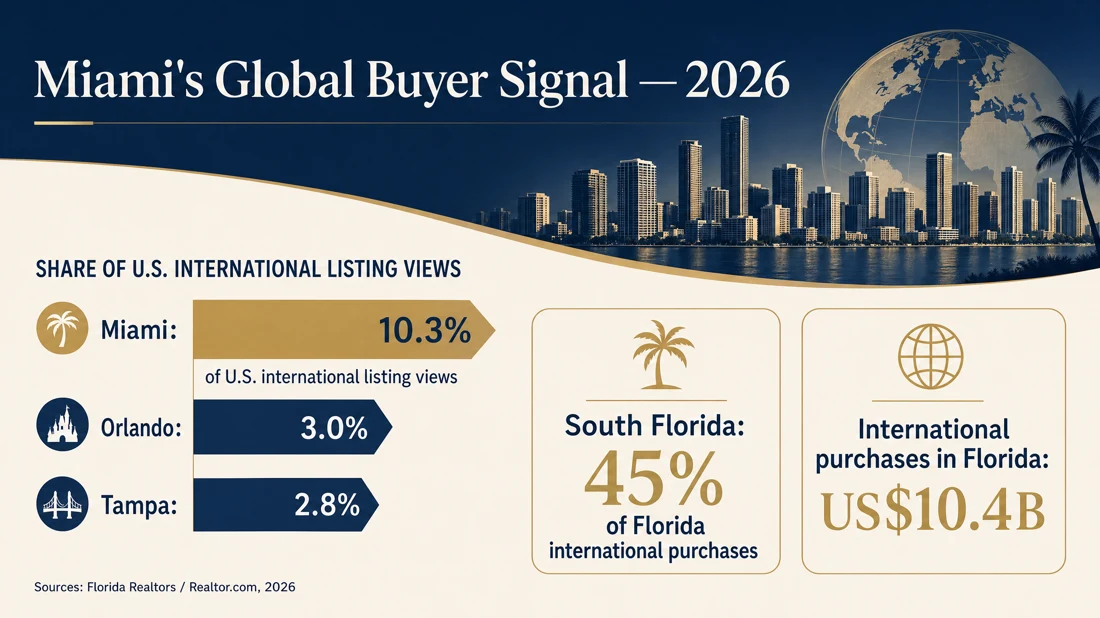
Miami accounted for 10.3% of international listing views on Realtor.com in the first quarter of 2026, the largest share among U.S. markets. That signal sits beside a deeper Florida trend: the state reported US$10.4 billion in international residential purchases in the most recent annual reporting period, while South Florida represented 45% of those purchases. These data points confirm that global demand is real. They do not, however, make every condominium, neighborhood or contract equally compelling.
For an international family, a Miami purchase is usually more than a real estate transaction. It can combine a second home, a future relocation option, dollar exposure, a family base and—in some cases—rental income. The more objectives a property is expected to serve, the more disciplined the selection process needs to be.
Demand is a signal, not an investment thesis
Global search interest can support a market, yet it cannot solve a weak association budget, an inflexible rental policy, an aging building system or a unit priced without a realistic resale audience. Miami-Dade’s June 2026 data showed a strong gain in total sales, while the condominium segment still carried meaningful inventory. That combination can create negotiation room for a well-prepared buyer, but it also requires better comparison work.
A useful starting point is to separate the market story from the asset story. The market story is that Miami remains highly visible to buyers from Latin America, Canada, Europe and elsewhere. The asset story is whether one specific unit has the building quality, monthly carrying cost, rental rules and exit profile that fit the buyer’s plan.

Four filters before the first serious offer
First, define the use case. A family home, a lock-and-leave second residence, a long-term rental and a flexible future relocation base may all point to different product types. A unit with strict rental limits can be ideal for personal use and unsuitable for an investor whose model depends on income.
Second, underwrite the ownership experience. Ask for the association budget, current fees, insurance information, reserve position, assessments, rental rules and pet or occupancy restrictions. Those documents reveal more about the real cost of ownership than a rendered view in a listing gallery.
Third, compare the exit audience. Liquidity is not a guarantee; it is a question of who could reasonably want the property later. A buyer should consider the neighborhood, building age, amenities, unit line, monthly cost and the buyer profile likely to be active at resale.
Fourth, organize cross-border execution early. Cash transfer timing, lending eligibility, ownership structure and closing logistics should be discussed before the search becomes emotional. A specialized real estate, lending, legal and tax team can help clarify the questions that depend on the buyer’s facts.
Florida’s international buyer data and Miami’s search leadership are summarized below. The figures describe market interest and transaction activity; they are not forecasts of future prices or returns.
Why the 2026 buyer can be more selective
MIAMI REALTORS described the condominium market as a buyer’s market in its 2026 outlook, with inventory providing more choice than buyers saw in earlier cycles. That does not mean every seller will negotiate or every building is equally resilient. It means a foreign buyer has a reason to ask better questions, compare alternatives and avoid compressing due diligence simply because Miami feels globally competitive.
The best search process therefore starts with a written decision framework: desired use, budget including carrying costs, neighborhood priorities, rental tolerance, preferred building age, liquidity horizon and financing or cash-transfer plan. It is easier to evaluate an appealing unit when the framework exists before the showing.
Questions international buyers should ask
Is the property chosen for personal use, rental income or both? The answer changes the acceptable rental rules and operating assumptions.
What is included in the monthly ownership cost? Review association fees, insurance, utilities, reserves and any known assessment discussions—not just the purchase price.
Who is likely to buy this unit later? Consider the building’s market position, unit characteristics and the level of recurring cost a future buyer will accept.
What needs professional confirmation? Financing, tax, immigration, ownership structure, insurance and contract questions should be reviewed with licensed specialists before capital is committed.
Talk to Faccin before choosing a Miami entry point
Miami’s global buyer signal can create urgency, but urgency is not a substitute for a property strategy. Faccin Investments helps international buyers compare neighborhoods, buildings, ownership costs, rental parameters and negotiation options in the context of a real acquisition plan. Contact Faccin Miami before committing to a specific unit or contract.
Editorial note: This article is informational only and is not legal, tax, lending or investment advice. International buyers should obtain guidance from appropriately licensed professionals for their specific circumstances.
Sources: Florida Realtors on international buyer search demand; Florida Realtors on international transaction activity; MIAMI REALTORS June 2026 market report; MIAMI REALTORS 2026–2027 outlook.