







Miami real estate is frequently presented as a high-demand, always-appreciating destination. And for single-family homes and ultra-luxury properties, that narrative holds. But Miami’s condo market in summer 2026 tells a different story — and for well-informed buyers, a potentially far more interesting one.
A specific combination of factors is creating a buying window that has not existed for at least five years: elevated inventory relative to recent history, median prices slightly below the prior year, mortgage rates still below projected year-end peaks, and a clear downward trend in inventory that suggests this window may close before the end of the year.
The Numbers That Matter
Condo inventory in Miami-Dade reached 12.9 months in July 2026 — firmly in buyer’s market territory. For context, the single-family market in the same period has only 5.2 months of supply, classifying it as a seller’s market. This divergence between the two segments is one of the most relevant phenomena in Miami real estate in 2026.
The median condo price in Miami-Dade stands at $415,000 — a 2.4% decline year-over-year. This pullback, combined with elevated inventory, means buyers have more options, more time to evaluate, and more negotiating leverage than at any point in the past 30 months.
Why Inventory Is Elevated — and Why That Will Change
Elevated condo inventory in Miami is not the result of weak demand. It is the result of a combination of structural factors: the impact of SIRS (Structural Integrity Reserve Study) reforms on older condos, rising association fees and insurance costs in buildings that require structural work, and the delivery of new preconstruction projects initiated in 2021 and 2022 when the market was at its peak.
Condo inventory in Miami-Dade declined for the fourth consecutive month in May 2026. This suggests that the elevated inventory window is closing. Buyers who wait for the “perfect moment” may find that the inventory and negotiating leverage that exist today will not be available at the end of 2026 or in 2027.
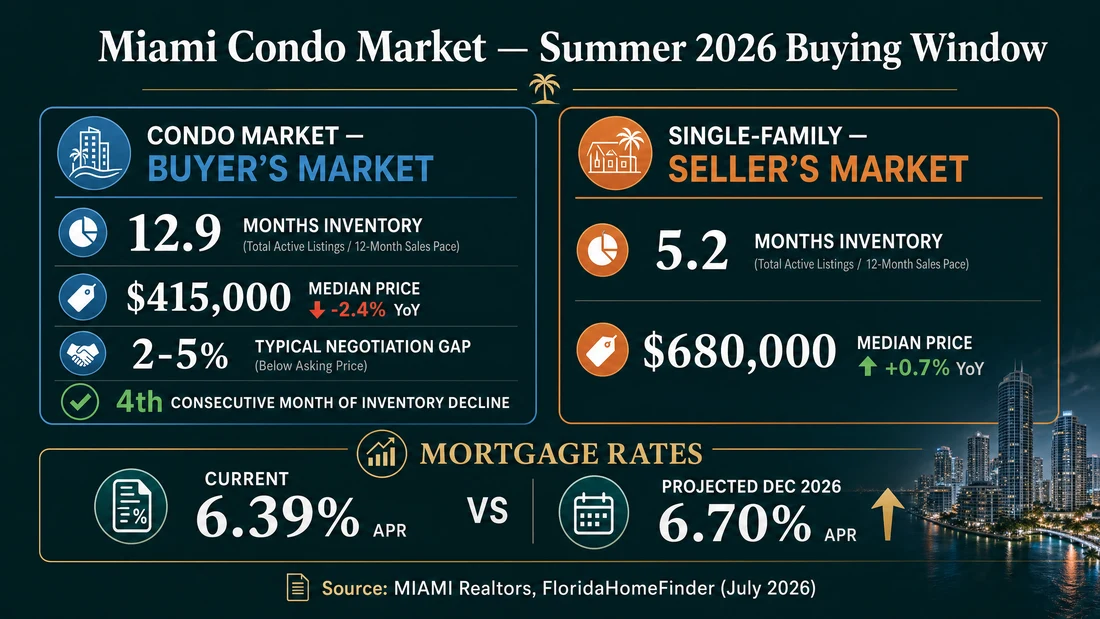
Key data: Miami-Dade condo market July 2026 — Inventory: 12.9 months (buyer’s market); Median price: $415,000 (-2.4% YoY); Typical negotiation gap: 2–5% below list price; 30-year mortgage rate: 6.39% APR; MIAMI Realtors projection for Dec 2026: 6.7%. Sources: MIAMI Realtors, FloridaHomeFinder (July 2026).
The Mortgage Rate Factor
Mortgage rates in July 2026 are approximately 6.39% APR for a 30-year fixed loan — elevated relative to historical norms, but still below projected peaks. MIAMI Realtors projects rates could reach 6.7% by December 2026. For buyers who depend on financing, this creates a clear temporal argument: buying now at 6.39% is potentially more favorable than buying in December at 6.7%.
How to Take Advantage of This Window
Summer 2026 rewards prepared buyers. Having financing pre-approval (or available liquidity for a cash purchase), a clear due diligence checklist, and access to specialized Miami market advisory are the three elements that separate buyers who capitalize on the window from those who let it pass. To explore the best condo opportunities in Miami this summer, contact Faccin Investments.
FAQ
Q: Is Miami’s condo market declining in 2026?
A: The median condo price in Miami-Dade fell 2.4% year-over-year to $415,000, and inventory stands at 12.9 months. However, inventory has declined for the fourth consecutive month, suggesting the opportunity window may close before the end of 2026.
Q: Is now a good time to buy a condo in Miami as an investment?
A: For buyers with a long-term horizon, proper due diligence, and the ability to distinguish quality condos from those with structural pressure, summer 2026 offers a favorable combination of inventory, price, and negotiating leverage.
Q: Are international buyers still purchasing Miami real estate in 2026?
A: Yes. International buyers continue to represent a significant share of Miami transactions, particularly in the luxury segment, where cash buyers account for approximately 58% of closings.