





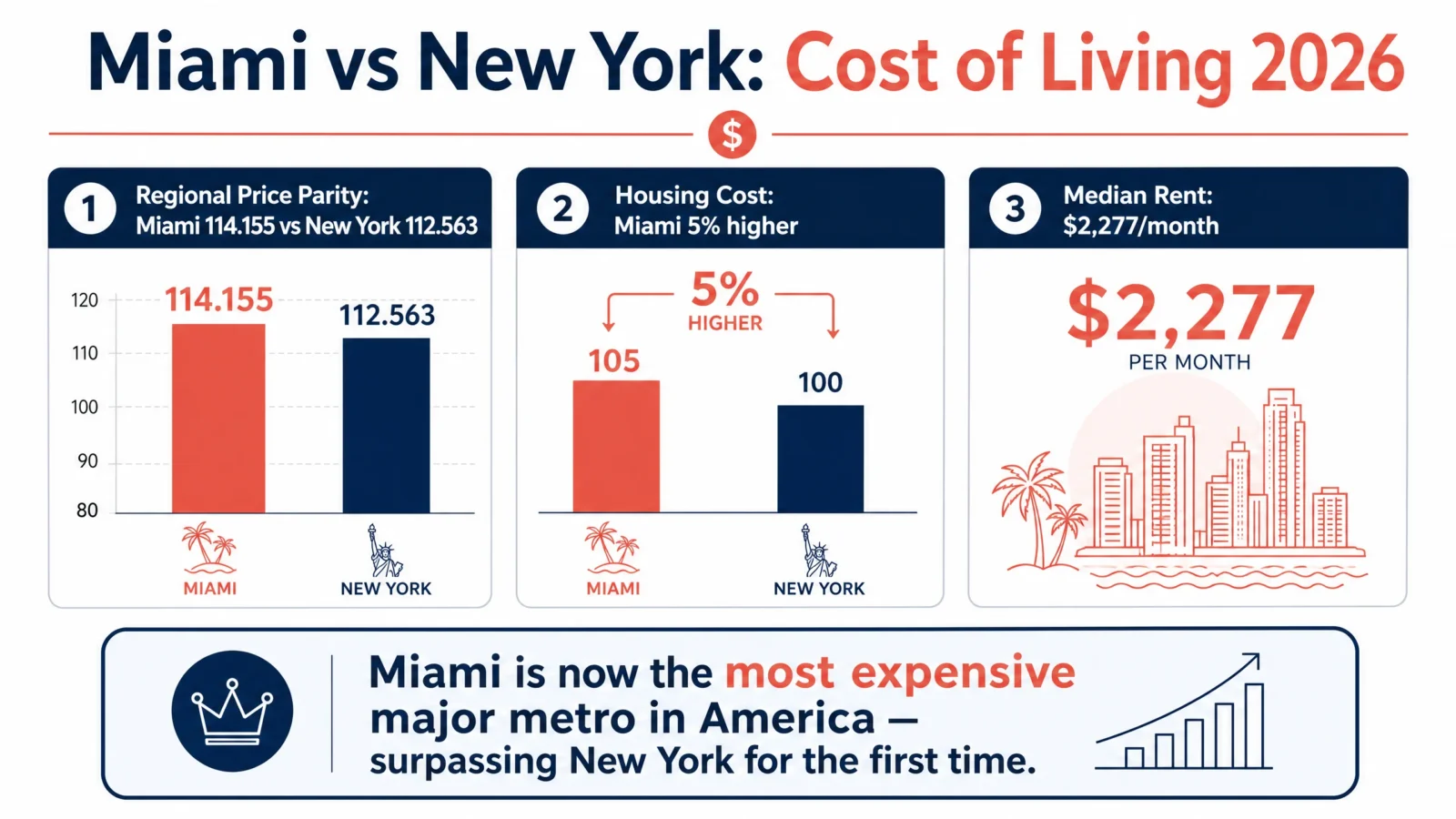
For the first time in recorded history, Miami has surpassed New York as the most expensive major metropolitan area in the United States. According to data from the Bureau of Economic Analysis (BEA), the Miami-Fort Lauderdale-West Palm Beach metro area now carries a Regional Price Parity (RPP) of 114.155 — meaning prices are 14.2% above the national average — compared to New York-Newark-Jersey City’s RPP of 112.563 (12.6% above average).
The milestone marks a dramatic shift in America’s cost-of-living hierarchy and raises critical questions for investors, residents, and international buyers evaluating South Florida real estate.
How Miami Became America’s Most Expensive Metro
The transformation didn’t happen overnight. Since 2019, the Consumer Price Index (CPI) for the South Florida region has surged 36%, driven by a perfect storm of factors: post-pandemic migration from high-cost states, limited housing supply, rising construction costs, and explosive growth in the luxury segment that pulled overall prices upward.
Miami’s housing market experienced an unprecedented boom during the COVID-19 era, as remote workers and wealthy migrants from New York, California, and Illinois relocated to Florida for tax advantages and lifestyle benefits. This demand wave collided with a structurally constrained supply of new housing, creating sustained upward pressure on both rental and purchase prices.

The Numbers Behind the Headline
The data tells a complex story. Miami’s median rental price stands at $2,277 per month — while this represents a 2.6% year-over-year decrease, it remains stubbornly high in absolute terms and ranks Miami 182 out of 182 metros on the affordability index. The median listing price for homes in the metro area is $499,000, compared to the $258,000 that housing affordability experts consider the threshold for “affordable” housing.
Perhaps most striking is the ALICE data: 41% of Miami-Dade County families are classified as ALICE (Asset Limited, Income Constrained, Employed) — meaning they earn above the federal poverty line but still cannot afford the basic cost of living in their community. This statistic reveals the growing disconnect between Miami’s luxury market and the reality for everyday residents.
The shortage of affordable housing is quantified by an alignment score of just 67% — well below the 100% ideal where supply matches demand across all price tiers. This structural shortage is a key driver of the region’s overall cost escalation.
What This Means for Real Estate Investors
Paradoxically, Miami’s rising costs signal both opportunity and caution for investors. On the positive side, the cost-of-living surge reflects strong economic fundamentals: a growing population, expanding employment in finance and technology, international capital inflows, and limited land for new development. These factors support long-term property appreciation.
However, the same data warns of potential overheating. When 41% of local families cannot afford basic living costs, the market becomes increasingly dependent on high-income domestic migrants and international buyers — a concentration of demand that can amplify volatility during economic downturns.
The Investor’s Perspective: Why Miami Still Attracts Capital
Despite rising costs, Miami continues to draw significant investment for structural reasons that go beyond short-term price movements:
No state income tax: Florida’s zero income tax remains a powerful draw for high-earners relocating from New York, California, and Illinois — effectively increasing their disposable income even as housing costs rise.
International gateway: Miami serves as the primary hub connecting North America with Latin America and Europe. For international investors, the city offers familiarity, cultural proximity, and ease of doing business that few other U.S. markets can match.
Limited supply: Geographic constraints (the Everglades, the ocean) and increasingly strict development regulations limit new construction, supporting prices over the long term.
Infrastructure investment: Major public works projects — including the Brightline expansion, port improvements, and the Miami-Dade transit overhaul — continue to enhance connectivity and property values.
Strategic Implications for Buyers
For international buyers and investors, the cost-of-living data provides valuable context for timing and positioning decisions. The key insight is that Miami’s expense is not a temporary anomaly — it reflects a structural transformation of the metro into a global city with world-class amenities, culture, and economic dynamism.
Key data: Miami RPP 114.155 vs New York 112.563 (BEA 2024 data, published Jul 2026) | CPI South Florida +36% since 2019 | Median rent $2,277/month | Median listing price $499,000 vs $258,000 affordable threshold | 41% of Miami-Dade families are ALICE | Affordability alignment score: 67%.
The Faccin Perspective
At Faccin Investments, we believe that understanding the macroeconomic context is essential for making sound real estate decisions. Miami’s cost-of-living rise is not a reason to avoid the market — it’s a reason to invest strategically. Properties in well-located, well-managed buildings with strong rental yields continue to outperform most comparable markets globally.
Our role is to help international buyers navigate this complex landscape with data-driven insights, identifying opportunities where the fundamentals justify the premium. Whether you’re seeking a primary residence, investment property, or diversification asset, Miami remains one of the world’s most compelling real estate markets.
Ready to explore what Miami offers? Contact Faccin Investments for a personalized market analysis tailored to your investment goals.