







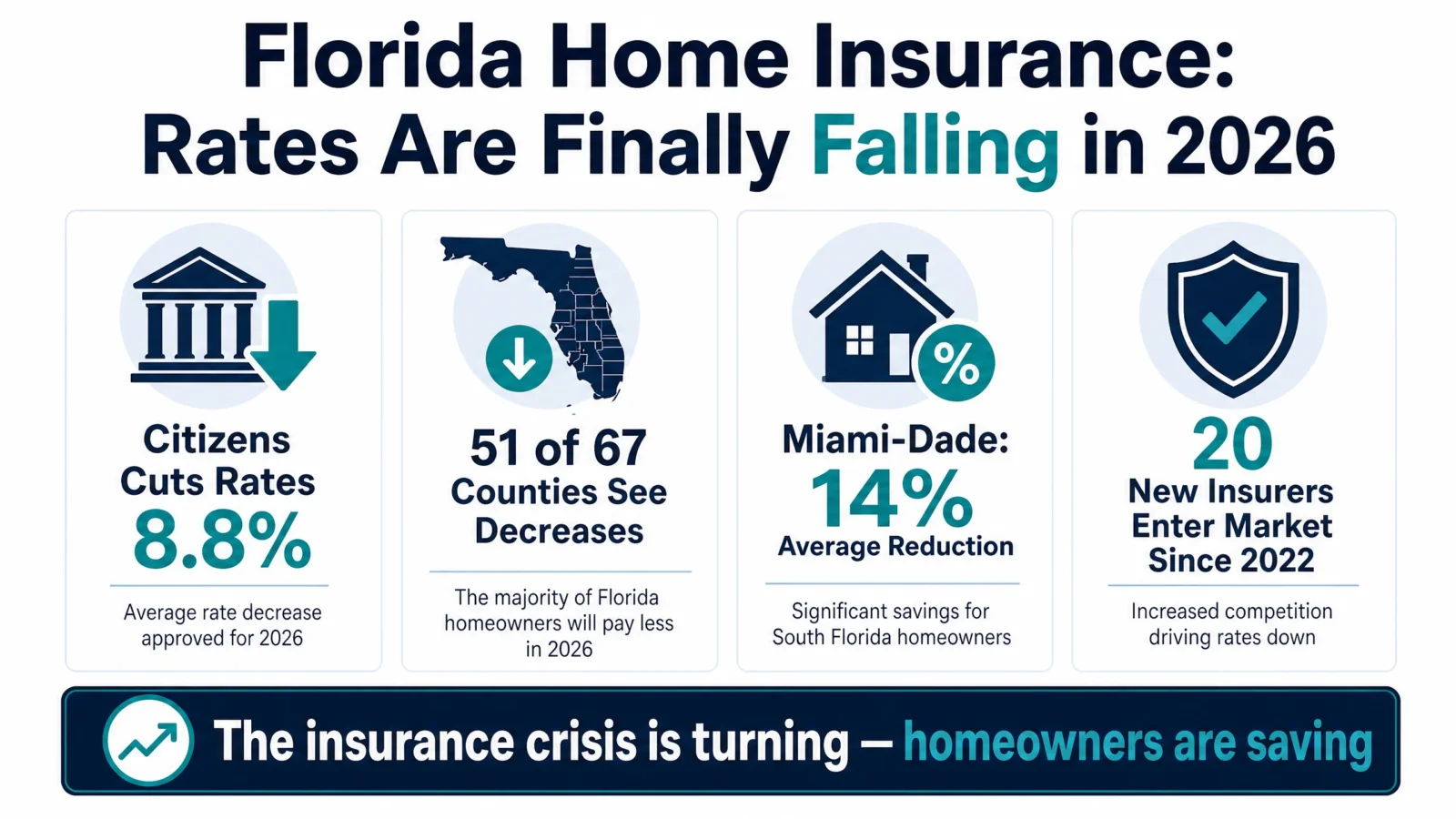
After years of spiraling premiums and market instability, Florida’s home insurance landscape is finally showing signs of meaningful recovery. In 2026, homeowners across the state are seeing significant rate reductions — led by a landmark 8.8% statewide cut approved for Citizens Property Insurance, the state’s insurer of last resort, and confirmed decreases across 51 of Florida’s 67 counties.
For international investors and prospective buyers evaluating South Florida real estate, this shift represents a fundamental change in the investment calculus that has weighed heavily on the market for nearly a decade.
The Scale of the Reduction
Citizens Property Insurance — which insures more than 1.8 million Florida homeowners who could not find coverage in the private market — approved an average rate decrease of 8.8% statewide for 2026. This marks the largest reduction in the company’s 24-year history, since its founding in 2002. The cut reflects a dramatically improved financial position driven by strong investment returns, favorable reinsurance pricing, and a hurricane season in 2025 that produced zero direct landfalls in Florida.
Beyond Citizens, the broader market is following suit. According to the Florida Office of Insurance Regulation, 51 of the state’s 67 counties experienced rate decreases in 2026. In Miami-Dade County specifically, homeowners are seeing average reductions of approximately 14% — a substantial improvement that directly impacts the operating costs of residential real estate in the region.

What Drove the Turnaround
The recovery is the result of several converging factors that began with Florida’s landmark insurance reform legislation in 2022:
Tort reform reduced litigation: The 2022 reforms eliminated one-way attorney fee provisions that had fueled an epidemic of frivolous insurance lawsuits. The number of property insurance lawsuits has declined significantly since the reform, removing a major cost driver from insurers’ expense base.
New market entrants increased competition: Since 2022, approximately 20 new insurance carriers have entered the Florida market, expanding capacity and driving competitive pricing. This influx of capital has fundamentally altered the supply-demand dynamics that previously allowed existing carriers to raise rates with impunity.
Reinsurance costs stabilized: Global reinsurance pricing — which had spiked after consecutive devastating hurricane seasons — has moderated as catastrophe modeling improved and capital returned to the market. Lower reinsurance costs translate directly into lower premiums for policyholders.
Favorable weather patterns: The 2025 hurricane season, which saw no direct Florida landfalls, allowed insurers to build surplus capital and demonstrate improved underwriting profitability to regulators.
What This Means for Real Estate Investors
The insurance cost decline has direct and meaningful implications for South Florida real estate investment returns. Historically, rising insurance premiums were the single largest drag on net operating income for residential properties — often adding $2,000 to $6,000+ annually to ownership costs for typical single-family homes and condos.
With rates now declining, investors can model more favorable cash flows. A 14% reduction in insurance costs for a Miami-Dade property could represent $500 to $1,500+ in annual savings — improving net yields and strengthening the case for acquisition. For properties financed with mortgages, lower insurance costs also improve debt service coverage ratios, potentially enabling larger loan amounts.
The trend also supports property values. As carrying costs decrease, the maximum price that investors and owner-occupants are willing to pay increases, all else being equal. This dynamic provides underlying support for Miami’s residential real estate market at a time when other cost pressures (property taxes, HOA fees) continue to rise.
County-Level Data: Where Rates Are Falling Most
The rate reductions vary significantly by county, reflecting local risk profiles and claim histories:
Miami-Dade: Average reduction of approximately 14% for homeowners. Current average annual premium: $6,045.
Broward: Average annual premium: $6,290, with decreases confirmed for 2026.
Palm Beach: Average annual premium: $6,614, with rate relief approved.
It’s important to note that while rates are declining, Florida homeowners still pay significantly more than the national average. The state’s unique exposure to hurricane risk means absolute premium levels will remain elevated compared to inland markets. However, the direction of change — from rising to falling — represents a meaningful inflection point.
Strategic Implications for Buyers
For international buyers and investors, the insurance trend change offers several strategic considerations:
Timing: Properties purchased in 2026 will lock in lower insurance costs from day one. Buyers who waited for insurance rates to stabilize now have concrete evidence that the market has turned.
Negotiation leverage: Sellers who have experienced insurance savings may be more motivated to transact, and buyers can use recent premium reductions as supporting data in negotiations.
ROI modeling: When underwriting potential acquisitions, investors should now model insurance costs based on current declining trends rather than historical escalation assumptions. This changes the net present value calculation favorably.
The Faccin Perspective
At Faccin Investments, we’ve advised clients through the entire insurance crisis cycle — from the premium spikes of 2021-2023 to the stabilization of 2024-2025 and now the reductions of 2026. Our guidance has always been data-driven: when insurance costs were rising, we factored that into our investment recommendations; now that they’re falling, we update our models accordingly.
The insurance recovery removes one of the most significant barriers to South Florida real estate investment. Combined with Miami’s strong economic fundamentals, international appeal, and limited supply, the improving insurance landscape makes 2026 an increasingly attractive window for strategic acquisition.
Key data: Citizens rate cut: 8.8% statewide (largest in 24 years) | 51 of 67 counties seeing decreases | Miami-Dade: ~14% average reduction | 20 new insurers entered market since 2022 | Post-2022 tort reform reduced lawsuits | Zero direct Florida hurricane landfalls in 2025.
Ready to explore South Florida real estate with updated cost assumptions? Contact Faccin Investments for a current market analysis that reflects the new insurance reality.