





Upland Park Miami-Dade has moved from a future development story to a location that can be evaluated in two different ways. Phase One has delivered 578 multifamily apartments beside the Dolphin Station Park & Ride Transit Terminal, leasing has begun, and residents are moving in. That makes the project relevant to people who need a home now. It does not turn the entire master plan into a completed neighborhood, and it does not turn an apartment lease into a condo purchase.
For a Latin American family relocating to South Florida, the useful question is not simply whether Upland Park is “near transit.” The better question is whether its current rental product, road access and daily connections fit the household’s actual week. Investors should ask a separate question: are they analyzing an apartment community as a rental option, or looking for an individually owned condominium? Those are different products, with different documents, costs and decision points.
What Phase One delivers today
The first phase is a multifamily rental community with studios and one-, two- and three-bedroom apartments, including selected layouts with dens. Public project information describes homes of approximately 700 to 1,528 square feet, with rents starting in the $2,000s at the time of the latest completion coverage. That figure is a published starting reference, not a universal price, a permanent offer or a guarantee of availability.
The practical change is that a renter can evaluate a finished building, a real move-in process, actual access to Dolphin Station and the first phase’s amenities. A renter can ask for the current rent sheet, concessions, utility structure, parking cost, pet rules, lease term and application requirements. A buyer comparing for-sale condos should not assume those terms describe a purchase opportunity at Upland Park.
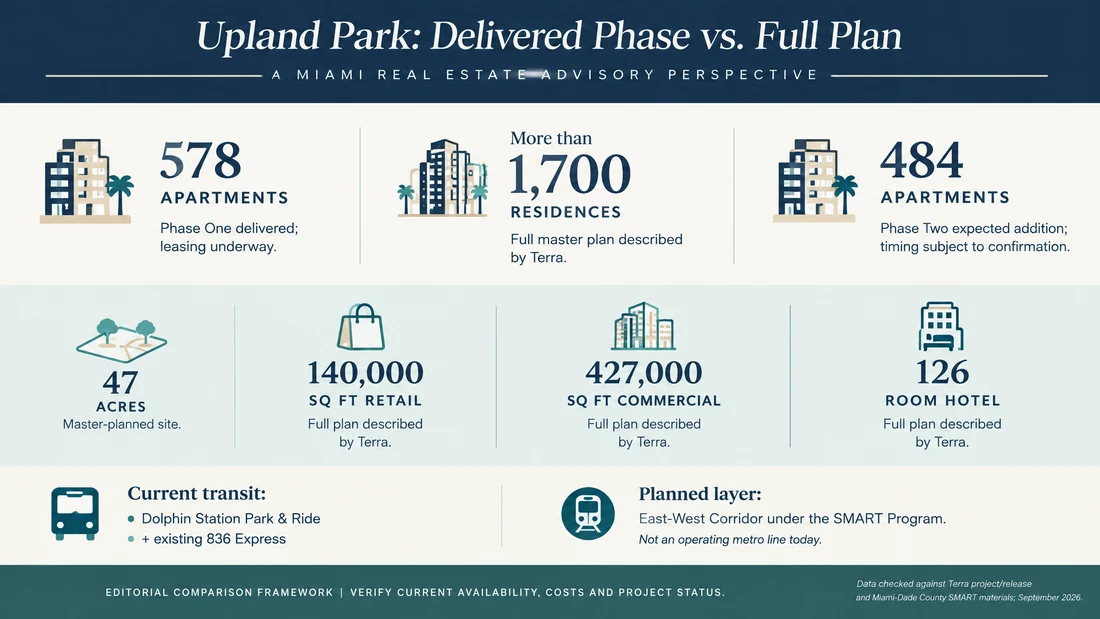
The full plan is larger than the delivered phase. Terra describes a 47-acre master-planned community with more than 1,700 residences, retail, commercial space and a 126-room hotel. A second residential phase of 484 apartments is expected to begin later in 2026. Future phases can change in timing, design, sequencing and availability. They should be treated as a development plan to monitor, not as inventory that is already delivered.
Start with the commute you will actually repeat
A transit-oriented address is only useful when the transit connection works for the trips that matter. Build a seven-day test before comparing Upland Park with Doral, an FIU-area address or a more central neighborhood.
| Trip to test | Questions to answer before choosing | Why it matters |
|---|---|---|
| Main job | What time must you arrive, and where is the last-mile connection after Dolphin Station? | A station nearby does not remove transfers, waiting or walking. |
| School or childcare | Is the route compatible with drop-off, pickup, activities and rainy-day logistics? | Family time can be shaped more by the school trip than by the commute to work. |
| FIU | Does the student need a direct trip, a car, a bus connection or a flexible schedule? | “Near FIU” is not the same as a predictable daily trip to a specific campus entrance. |
| Airport or central Miami | How often will the household travel to MIA, Downtown, Brickell or the Health District? | The best location depends on trip frequency, not a single map distance. |
| Weekend errands | Can the household handle groceries, medical visits and activities without adding a second car? | A transit-oriented plan can still require a car for ordinary daily life. |
Drive or simulate the route at the actual departure times. Test school-day traffic, peak-hour traffic, tolls, parking and the time between the station, the destination and the front door. Compare the result with the same routine from Doral, an FIU-area location and one central alternative. This is more useful than ranking neighborhoods by a generic “commute-friendly” label.

Read the road network without oversimplifying it
Upland Park is close to Florida’s Turnpike and State Road 836, the Dolphin Expressway. That can support access across West Miami-Dade and toward Doral, the airport and central employment areas. It can also expose a household to tolls, peak congestion, incident-related delays and parking costs. Road proximity is an option, not a travel-time promise.
The Dolphin Station connection is already relevant because it serves an existing transit hub and the 836 Express service. The planned East-West Corridor is a different layer. Miami-Dade describes that corridor as part of the SMART Program, running between the Tamiami area and the Miami Intermodal Center near Miami International Airport. The county’s adopted concept involves bus rapid transit elements and dedicated transit infrastructure, but future planning and implementation do not mean that a new rail line or completed premium service is operating at the property today.
That distinction should change the way a buyer or renter models the address. Count current service as current service. Treat future corridor benefits as a possibility that requires status checks, not as a guaranteed feature in a valuation, budget or school decision.
Separate what exists from what is planned
The master plan adds context, but the delivered phase should carry the greatest weight in a near-term relocation decision. Use a phase-by-phase checklist rather than treating the whole rendering or site plan as one finished place.
| Item | Delivered phase | Future plan or open question |
|---|---|---|
| Housing | 578 multifamily apartments with leasing underway | More than 1,700 residences are planned across the master plan; later phases are not the same as current inventory. |
| Ownership model | Rental apartments | Do not assume an individual condo title, resale market or purchase contract. |
| Transit | Dolphin Station Park & Ride and existing service | East-West Corridor improvements remain a planned SMART Program component. |
| Retail and commercial | Part of the broader mixed-use vision; confirm what is open on the visit | Terra describes 140,000 square feet of retail and 427,000 square feet of commercial space at full plan. |
| Hospitality | Not a substitute for a completed residential amenity or school ecosystem | The full plan includes a 126-room hotel. |
| Next phase | Phase Two is expected to add 484 apartments | Confirm approvals, construction timing, delivery and leasing status directly. |
An in-person visit should include the station path, the street crossings, the building entrance, parking circulation, noise at the relevant hours and the services that are actually open. Ask which features are controlled by the current property, which depend on later phases and which depend on public agencies.
Compare Upland Park with Doral, FIU and central areas by household profile
Upland Park may fit a renter who values a newer apartment community, access to a major road network and the option to use the Dolphin Station hub. Doral may fit a household whose employment, school routine, social network or existing services are already concentrated there. An FIU-area location may reduce the friction of a student’s daily routine even if it does not optimize every adult commute. Central areas may shorten selected trips while increasing housing, parking or monthly carrying costs.
There is no universal winner because the comparison changes with the household’s anchor destinations. A family should score the morning drop-off, work arrival, afternoon pickup and evening activities. A relocating professional should test the commute in both directions and include tolls, parking and rideshare contingencies. An investor should compare the total cost and legal structure of the product, not just the headline monthly rent in a nearby rental community.
If you are an investor, do not compare rent to condo appreciation
The first phase gives Upland Park a real rental-market reference. It does not provide a public condo sales price, a guaranteed rental return or a basis for promising appreciation. For an investment comparison, separate these questions:
- What is the asset? A multifamily rental community, a condo unit, a land position and a pre-construction contract are not interchangeable.
- What is the cost? Include rent or purchase price, parking, insurance, taxes, association or operating costs, utilities, management and reserves where applicable.
- What is the evidence? Use current lease terms and verified operating information for a rental analysis. Do not turn a master plan, a future corridor or a nearby project into a guaranteed market outcome.
- What is the timing? Confirm whether the decision concerns a delivered building, a phase under construction or a later plan.
- What is the exit? A renter can renew or move. A condo owner must consider resale, financing, closing costs, restrictions and the depth of buyer demand.
A careful comparison may conclude that Upland Park is useful as a relocation rental without being a condo acquisition opportunity. That is not a contradiction. It is a product distinction.
A practical shortlist for a relocation decision
Before applying for a lease or moving a condo search forward, request the current availability and cost sheet, then verify the route to work, school and the airport at the times your household will travel. Compare the same worksheet with Doral, FIU and one central alternative. Record what is open today, what is scheduled for a later phase and what remains a public transit plan.
For families, the decision should be made around the week that actually happens, including school pickup, a second adult’s commute and the need for a car. For investors, the decision should be made around the asset’s legal form, operating costs, documentation, liquidity and evidence rather than a broad transit-oriented-development narrative.
If Upland Park Miami-Dade is on your shortlist, Faccin Investments can help organize a side-by-side review of location, housing type, phase, current availability, commute assumptions and total costs. The goal is not to push one neighborhood. It is to clarify which option matches your actual move or acquisition criteria.
FAQ
Is Upland Park a condo development for individual buyers?
The delivered first phase is described as multifamily apartments with leasing underway. That is a rental offering, not the same as an individually titled condominium sale. Confirm the legal and commercial structure of any future phase before treating it as a purchase opportunity.
Is the East-West Corridor already operating as a metro or rail line?
No. The current connection is the Dolphin Station Park & Ride hub and existing transit service. The East-West Corridor is a planned SMART Program corridor that includes future premium transit work. Do not model it as an operating metro line today.
Are the published rents guaranteed?
No. Published starting rents are time-specific references. Actual pricing, fees, concessions, floor plans and availability can change by date and unit.
Is Upland Park better than Doral or an FIU-area address?
That depends on the household’s destinations and schedule. Compare door-to-door travel, school logistics, road and toll exposure, parking, services, housing type and current costs rather than relying on a neighborhood ranking.
Does the full Upland Park plan guarantee appreciation?
No. The scale of the plan and its transit-oriented design are facts to evaluate, not a promise of appreciation, return or future market performance.
Contact Faccin Investments to discuss the next step with Faccin Investments.