




What the vote means
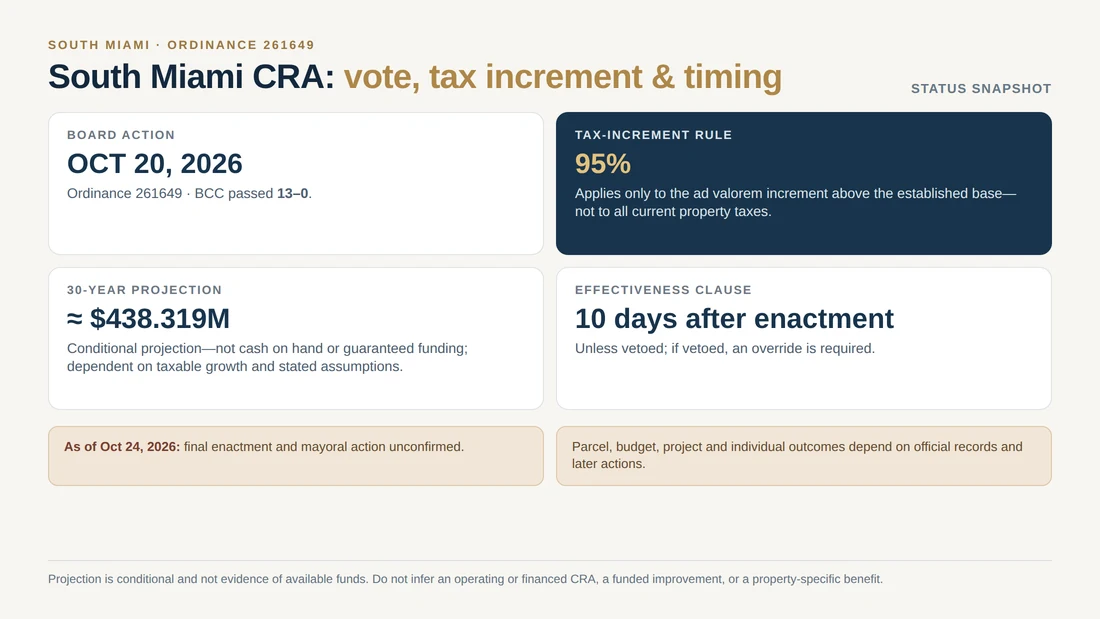
Miami-Dade’s Board passed ordinance 261649 by a 13–0 vote on October 20, 2026. The measure concerns a proposed Community Redevelopment Area, or CRA, in South Miami. That vote is an important procedural step, but it is not the same as saying the CRA is already effective, operating, or financed. As of October 24, 2026, the final enactment date and mayoral action had not been confirmed.
Where the proposed area is located
The proposed CRA covers approximately 238 acres and is generally described as the area between SW 62nd Street, SW 76th Street, SW 57th Avenue/Red Road, and SW 62nd Avenue. “Generally” matters: owners and buyers should not assume that every parcel inside a broad boundary is included, or that a parcel near a boundary is excluded. Parcel-level confirmation should come from the adopted legal description and the official record, not from a neighborhood map or a marketing summary.
How the tax-increment concept works
The ordinance provides for 95% of the ad valorem increment above the established base to be applied under the CRA framework, subject to the ordinance and the redevelopment plan. This does not mean that 95% of every current property-tax dollar would be diverted. The relevant calculation is the increase above the base, and the amount can change with assessed values, tax rates, exemptions, appeals, and other assumptions. The framework also does not erase an owner’s ordinary tax obligations.

What the $438.319 million projection does—and does not—say
The materials project approximately $438,319,000 over 30 years. That figure is a long-range estimate dependent on taxable growth and stated assumptions. It is not a cash balance, a guaranteed allocation, or proof that funds are currently available. Spending would remain tied to eligible uses in the redevelopment plan, budget decisions, and applicable requirements. The projection therefore should be read as a conditional planning scenario, not as a promise of construction or a guaranteed improvement to any property.
What this means for owners and buyers
For a current owner, the vote may be relevant to future public-realm planning, project review, and the way nearby redevelopment proposals are discussed, but the vote alone does not promise a project, a permit, a value increase, or a special benefit. For a buyer, the CRA topic belongs in due diligence alongside zoning, future land-use designations, permits, assessments, liens, flood exposure, code matters, and any pending public actions. Ask which legal parcel description applies, what stage the ordinance has reached, and whether a referenced project has an approved budget and a defined funding source.
Short FAQ
Is the CRA already in effect?
The effective status had not been confirmed as of October 24, 2026. The clause provides for effectiveness ten days after enactment unless vetoed; after a veto, it would require an override. Enactment and mayoral action still need confirmation.
Does the vote change my tax bill now?
Do not assume that it does. The 95% language concerns the ad valorem increment above the base, not 95% of the entire current tax bill.
Will my property receive improvements?
That cannot be promised from this vote. Eligibility, plans, budgets, and later actions would control.
For a parcel-specific review of the public record and surrounding real-estate considerations, contact our team.