


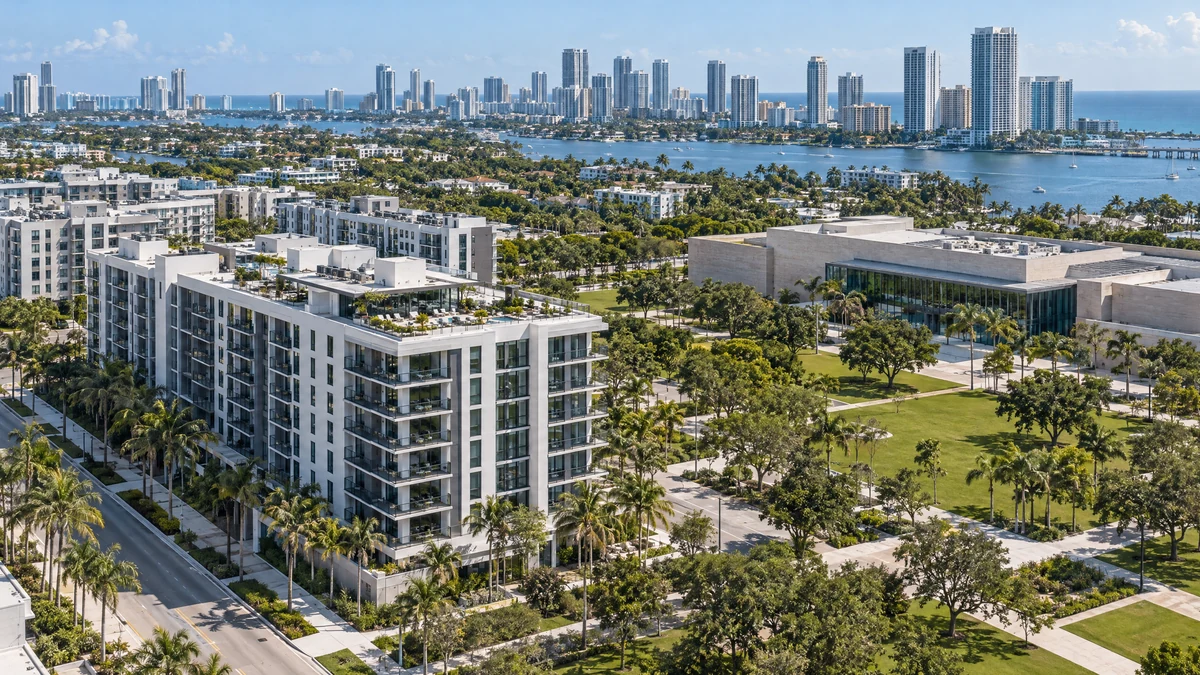
Florida’s Live Local framework enters a more detailed phase
Florida’s Live Local Act has been changed by CS/CS/HB 1389, Chapter 2026-179. The governor approved the bill on June 26, 2026, the chapter law was recorded on June 29, and the changes took effect on July 1, 2026. For owners, developers and buyers in South Florida, the important point is not a blanket expansion of development rights. The law creates or refines pathways for certain parcels, subject to the facts of the site, the applicant and the proposed project.
The legislation addresses certain government-owned and school-owned land, along with land owned by qualifying religious institutions. A religious-institution scenario requires more than three acres and a place of worship that has operated at the location for at least 10 years. It also includes requirements about the applicant and the continuity of the place of worship. These conditions make ownership history, organizational documents and site operations part of the initial real estate review, rather than items to be checked only after a concept is designed.
What the religious-land pathway signals
Where the religious-land criteria apply, at least 40% of the residential units in the multifamily development must be affordable rental housing for at least 30 years. That long operating horizon affects underwriting, unit mix, financing assumptions, management planning and the way a buyer evaluates future flexibility. It also means that a preliminary yield calculation cannot be treated as a conclusion about project feasibility.
The law also addresses height, setbacks, exceptions and assemblage in specific conditions. Those provisions may matter when a parcel is being combined with adjacent land or when a proposed design interacts with existing dimensional rules. Their effect depends on the applicable category, the parcel’s configuration, the proposed use, the application and other zoning and development reviews. A site that appears eligible at a high level may still require a different design, additional documentation or a different approval path.
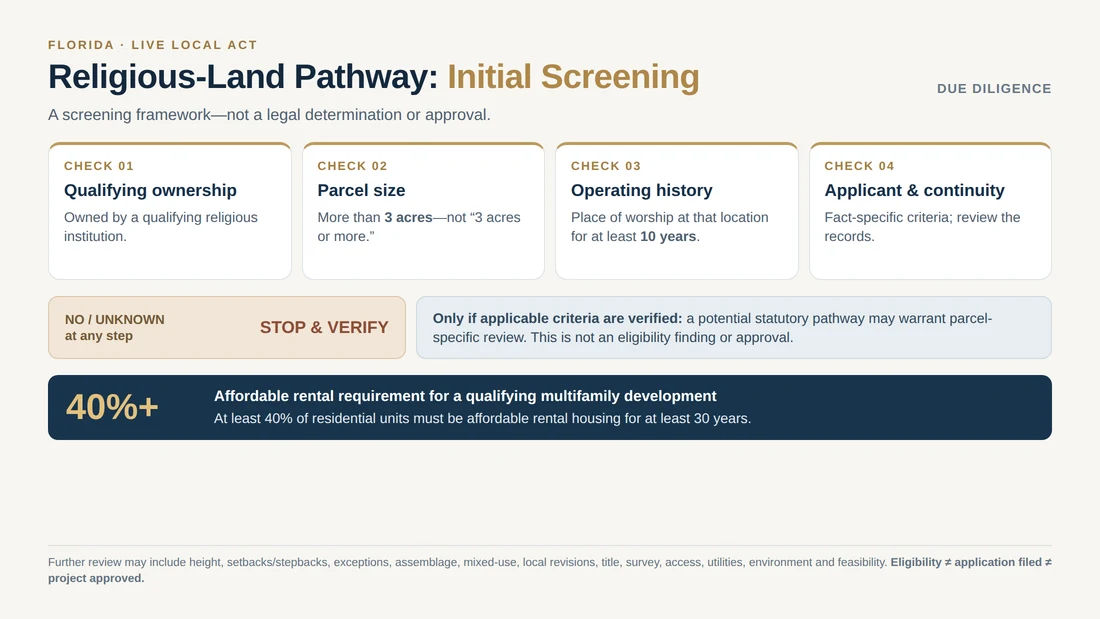
Due diligence checklist for a Florida parcel
1) Confirm the ownership category and the exact legal description. 2) Verify acreage, parcel boundaries, easements, access and any assemblage plan. 3) Document the history and continuity of a qualifying place of worship when the religious pathway is being considered. 4) Identify the applicant, control structure and supporting eligibility records. 5) Model the required affordable rental share and 30-year period in the project’s operating case. 6) Test height, setbacks, exceptions, parking, utilities and other local requirements against the actual site. 7) Obtain a parcel-specific zoning, title, survey, environmental and financial review before relying on a development scenario.
FAQ
Does HB 1389 make every parcel eligible? No. Eligibility depends on the applicable statutory criteria, parcel facts, application, zoning and other reviews.
Is the 40% affordable-rental requirement universal? The supplied religious-land scenario includes that requirement; it should not be generalized to every Live Local Act pathway.
What is the practical takeaway? Treat the law as a structured screening opportunity, then verify every condition before pricing land or promising a project outcome.
For a Florida property review grounded in the parcel’s facts and the project’s objectives, contact Faccin Investments.