





Carnegie Mellon University’s planned Miami campus gives Wynwood a powerful new narrative: a global research university, a large institutional commitment and a potential new anchor for knowledge-driven activity. For a buyer choosing a primary home, second home or relocation base, that narrative is relevant—but it is not the same as a delivered feature. The disciplined question is what can be evaluated today, what belongs to a longer horizon and what remains unproven.
Ken Griffin committed more than US$3 billion to Carnegie Mellon, with US$2 billion supporting the launch of CMU Miami and the rest supporting the Pittsburgh campus. CMU Miami is planned as a 35-acre campus in Wynwood, subject to necessary regulatory approvals. Those facts make the project meaningful; they do not make a future price effect measurable today.

The headline is long; the timeline is longer
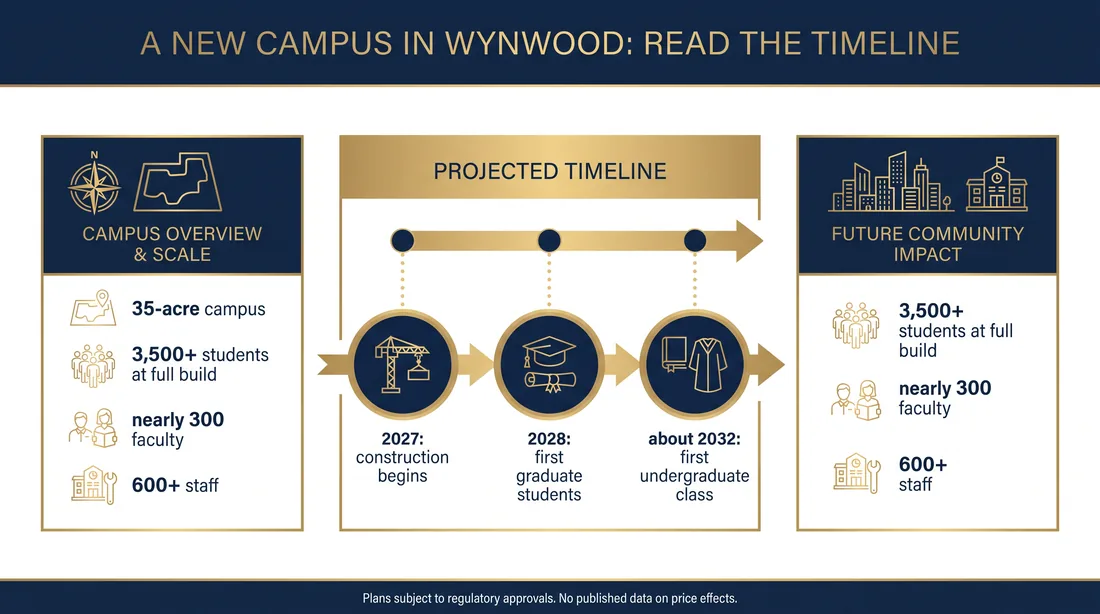
Construction is slated to begin in 2027. The first graduate students are expected in 2028, while the first undergraduate class is expected later, around 2032. At full build, the plan calls for more than 3,500 students, nearly 300 faculty and over 600 staff. That sequence matters because each milestone describes a different level of reality. A site under approval is not a construction site; a construction site is not an operating campus; and an operating graduate program is not the full student ecosystem.
The land story also explains why the announcement carries weight. The Wynwood land was assembled over roughly fifteen years, and about 30 acres changed hands in a transaction reported at about US$1.1 billion, all cash. That is a substantial commitment to a physical place. It is also a reminder that the urban transformation will unfold in stages rather than arrive in one opening-day moment.
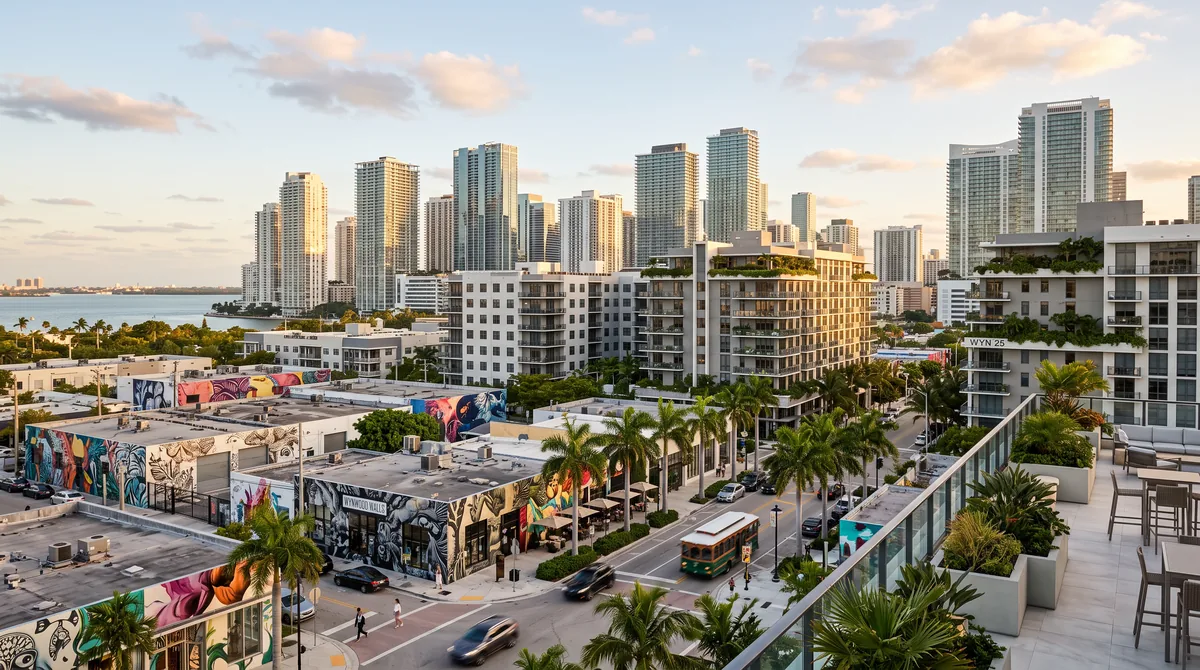
Wynwood has changed character more than once. It evolved from a 1920s garment district into an arts district, with Wynwood Walls established in 2009, then into a business and technology district with offices of large technology companies. CMU Miami adds an institutional layer. The responsible reading is a history of change to observe, not a guarantee about the next phase.
Three locations, three buyer questions
Wynwood is the clearest place to test a rental-demand thesis within walking distance of the planned campus. Proximity and convenience may matter to future students, faculty, staff or visitors, but that is not proof of rent levels, occupancy or a purchase premium. Evaluate an apartment for current life rather than pricing in a tenant who has not arrived.
Edgewater asks a different question. Its waterfront setting may appeal to buyers who want a residential atmosphere and the broader Miami experience. The CMU story may enter the conversation, but a future campus is not a delivered feature of an Edgewater home. Evaluate the actual building, view, access, maintenance profile and daily fit.
Brickell is a separate comparison: a buyer may prioritize an established urban base, professional convenience and a trophy waterfront market rather than walking distance to a planned academic campus. Do not use a rental-demand thesis near a future campus as a shortcut to value a premium waterfront home; different use cases require different evidence.
| Buyer lens | Wynwood | Edgewater | Brickell |
|---|---|---|---|
| Main question | Is current life and potential campus proximity compelling without assuming a premium? | Does the real waterfront setting work independently of the campus story? | Does the established urban and waterfront proposition fit the buyer’s purpose? |
| Rental thesis | Test walkability and future absorption carefully. | Treat campus proximity as secondary to the actual home. | Keep a future-campus thesis separate from trophy waterfront pricing. |
| Near-term trade-off | Construction may affect routes, noise and access. | Compare daily convenience with the building’s lived experience. | Avoid paying for a distant narrative that does not define the asset. |
Construction is part of the decision
A 35-acre build brings years of trucks, cranes and closed lanes before a completed academic environment. It can affect routes, sightlines, noise tolerance and arrival. For international buyers and second-home owners, these details shape visits before the campus opens. Ask what the site plan implies for density and housing, activity and access.
The prudent pricing discipline is simple: do not price a 2032 campus into a 2026 purchase as if the benefit were already present. Doing so risks paying twice—once for the home as it exists and again for an expectation that still has to pass approvals, construction and demand tests. No published data shows a price effect on homes in Wynwood, Edgewater or Brickell as of the announcement. That absence is not a negative forecast; it is a reason to keep the underwriting anchored in observable conditions.
The watch list should be explicit: necessary regulatory approvals; site plan density and housing; rental absorption, without assuming every projected student or employee becomes a nearby renter; and neighborhood disruption, including trucks, cranes and closed lanes. A buyer can see long-term relevance without converting optimism into today’s price.
Frequently asked questions
Is CMU Miami already an operating amenity for a nearby home?
No. It is a planned 35-acre campus subject to necessary regulatory approvals. Construction is slated for 2027, graduate students are expected in 2028 and the first undergraduate class is expected around 2032, so a future campus is not a delivered feature.
Does the announcement prove that Wynwood, Edgewater or Brickell prices will rise?
No published data shows a price effect on homes in those neighborhoods as of the announcement. The project can be important without providing proof of appreciation or a guaranteed purchase premium.
Should a buyer ignore the campus until 2032?
Not necessarily. The better approach is to watch approvals, density and housing, rental absorption and disruption while valuing the home on its current qualities. A buyer may keep the long horizon in view without paying for an unbuilt outcome.
Which location is best for a campus-related rental thesis?
Wynwood is the logical place to test a within-walking-distance thesis. Edgewater and Brickell require a separate analysis because waterfront living and an established urban base are distinct propositions.
A measured next step
For a primary home, second home or relocation base, compare the home you can inspect now with the city you may see later. Review the building, the immediate surroundings, the likely construction experience and the evidence behind any rental assumption. If the campus story is part of your decision, keep it as a monitored scenario—not a promise of appreciation, return or financing approval—and make your next comparison with Contact Faccin Investments.