







For an entrepreneur or family office using Miami as a business base, a furnished residence with a dedicated office sounds more consequential than a condo with a coworking lounge. The difference is structural: the residence is one property, while a separately deeded office may be a second property with its own use, carrying costs, tenant profile, and resale market.
That is the thesis behind One Twenty Brickell Signature Residences, the second phase of the One Twenty Brickell concept in Brickell. Public project material describes a 40-story tower with 467 furnished residences, each paired with a private dedicated office suite. The first One Twenty Brickell tower is described by its developer as a 34-story, 240-residence residential-and-office project and is listed as sold out. The newer project is being marketed as a live-work solution, not as a guaranteed income product.
The investor question is therefore narrower and more useful than “Does the office add value?” It is: after reviewing the legal documents, condo rules, operating costs, rent evidence, vacancy, and exit market, does this particular office behave like an independently valuable asset?
The One Twenty Brickell private office is a two-asset hypothesis
A pool, gym, lounge, or conference room can improve a building’s appeal, but an amenity is normally consumed collectively. It does not have an independent title, rent roll, or resale process. A deeded office is different in principle. It may be used by the owner, leased to another professional, held vacant for strategic use, or sold separately — but only if the recorded documents and condominium rules actually support those possibilities.
The word “may” is doing important work. Project pages and press coverage describe individually deeded office suites, private access, conference-room access, reception or concierge support, and office fit-out. They also state that representations are conceptual and that final prices, square footage, availability, specifications, and legal rights must be checked in the offering documents, purchase agreement, declaration, and related exhibits.
For a buyer, the residence and office should be underwritten as two connected but distinct decisions:
- Residence: Does the home work for personal use, a Miami base, or permitted residential leasing?
- Office: Does the office work for the buyer’s business, an identified tenant segment, or a realistic resale strategy?
A bundled transaction should not make the second question disappear.
What the public facts establish — and what they do not
The public record supports a useful starting point: the Signature project has been presented as a 40-story, 467-residence tower with deeded private offices and more than 50,000 square feet of planned amenities. The earlier One Twenty Brickell Residences tower had 240 residences and dedicated office suites and is identified by PMG as sold out. Brickell’s location, proximity to Brickell City Centre, transit connections, and concentration of professional services help explain the product’s target market.
Those facts do not establish a rent, a net yield, guaranteed availability, financing terms, appreciation, immigration benefit, or a ready-made tenant for any particular office. Nor do they prove that every office has the same size, view, access, cost, permitted use, or resale depth. The legal description and recorded condominium documents matter more than the sales shorthand.
A due-diligence checklist for the office as an asset
The objective is to replace a lifestyle promise with evidence. A buyer should request the documents and data below for the exact residence and office being considered.
| Test | What to verify | Decision question |
|---|---|---|
| Owner use | Can the buyer operate the intended professional activity? Are clients, staff, deliveries, hours, security, signage, and furniture controlled by rules? | Does the office solve a real business need, or would a flexible office nearby do the same job for less? |
| Residential leasing | The residence’s minimum lease term, approval process, short-term rental limits, guest rules, and management requirements. | Can the residence be occupied, leased, or reserved in the way the buyer expects? |
| Office leasing | Whether the office can be leased to a non-owner, whether the tenant must be an owner or approved professional, and whether subleasing is restricted. | Is there a legally permitted rental strategy, not merely a sales presentation? |
| Permitted use | Declaration, bylaws, rules, zoning, certificates of occupancy, professional-use limitations, and any restrictions on medical, financial, client-facing, or high-traffic activities. | Is the intended use expressly permitted and operationally practical? |
| Title | A title commitment, legal description, separate parcel or unit treatment, easements, appurtenances, liens, and whether the office can be conveyed independently. | Is this an independently transferable real estate interest, or an office right tied to the residence? |
| Condominium rules | Recorded declaration, amendments, bylaws, current rules, meeting minutes, budgets, reserves, insurance, management agreements, and leasing policies. | Do the documents protect the office’s use and future transferability? |
| HOA and assessments | Separate or combined association fees, office-specific charges, utilities, concierge, conference-room access, reserves, special assessments, and future budget pressure. | What is the office’s complete annual carrying cost? |
| Property taxes | The exact parcel or unit assessment, tax history when available, projected millage, exemptions, and whether residence and office are assessed separately. | Does the underwriting use a real tax estimate rather than a residential guess? |
| Insurance | Association master policy, owner policy requirements, contents, liability, business coverage, hurricane deductible, flood exposure, and tenant requirements. | Who pays for which risk, and what gap remains after the association policy? |
| Vacancy | Base, conservative, and stress vacancy assumptions; lease-up time; tenant improvements; commissions; renewal probability. | Does the office remain viable with months of zero rent? |
| Liquidity | Comparable office sales, days on market, buyer pool, price per square foot, transfer restrictions, and demand outside the building’s own residents. | Could the owner sell the office without relying on the original marketing story? |
| Tenant demand | Comparable rents in Brickell, tenant profiles, small-suite absorption, professional services demand, and competition from flexible offices. | Is there durable demand for this specific size, address, access, and format? |
The same discipline applies to the residence. A Brazilian buyer should separate personal use from investment use, clarify currency exposure and funding source, and model the property in U.S. dollars before treating any rent as a portfolio return.

Conceptual editorial illustration: the office thesis only becomes investable after the buyer connects title, use, rules, and operating evidence.
Gross rent is not net cash flow
The frequently discussed figure of up to US$80,000 per year should be treated as commercial potential, not promised rent and not a guaranteed return. It may describe a gross revenue opportunity under a specific rent, occupancy, size, and tenant scenario. It does not tell the buyer what remains after vacancy, HOA, taxes, insurance, management, maintenance, tenant improvements, leasing commissions, financing, closing costs, or income taxes.
The following illustration is intentionally hypothetical. It is not a quote for One Twenty Brickell, does not assume a particular office size, and does not imply availability. It shows why gross and net must be separated before a buyer assigns value to the office.
| Annual office scenario | Base case | Conservative case |
|---|---|---|
| Potential scheduled gross rent | US$80,000 | US$60,000 |
| Vacancy and non-collection assumption | 10% / −US$8,000 | 15% / −US$9,000 |
| Effective collected rent | US$72,000 | US$51,000 |
| HOA and office-related assessments | −US$18,000 | −US$18,000 |
| Property taxes | −US$10,000 | −US$10,000 |
| Insurance | −US$3,500 | −US$3,500 |
| Management and leasing administration | −US$5,760 | −US$4,080 |
| Maintenance and replacement reserve | −US$3,000 | −US$3,000 |
| Illustrative net operating cash flow before financing and income tax | US$31,740 | US$12,420 |
| Net cash flow as a share of scheduled gross rent | 39.7% | 20.7% |
The assumptions are the point of the exercise, not the output. A different HOA, tax bill, insurance premium, lease-up period, management arrangement, or special assessment can materially change the result. A cap rate or cash-on-cash return also cannot be calculated responsibly without the office’s actual allocated purchase price and acquisition costs.
The market backdrop is selective, not automatic
Recent reporting on Miami office conditions describes a market with strong differentiation. Prime, well-located, service-rich space can attract tenants even while overall office vacancy remains meaningful. That is not the same as a generalized shortage of offices. A small office attached to a luxury residential ecosystem may appeal to entrepreneurs, family offices, independent professionals, and firms seeking a representative address. It can also compete with traditional Class A suites, managed offices, coworking products, and other deeded-office developments.
The office therefore needs its own demand proof. Ask for signed leases or comparable executed transactions where available, not just asking rents. Compare the total occupancy cost with a conventional Brickell suite. Test whether an outside tenant would pay for the building’s services or whether only a resident-owner finds the package compelling. Finally, model the time and cost of finding a new tenant when the original owner’s network is no longer available.
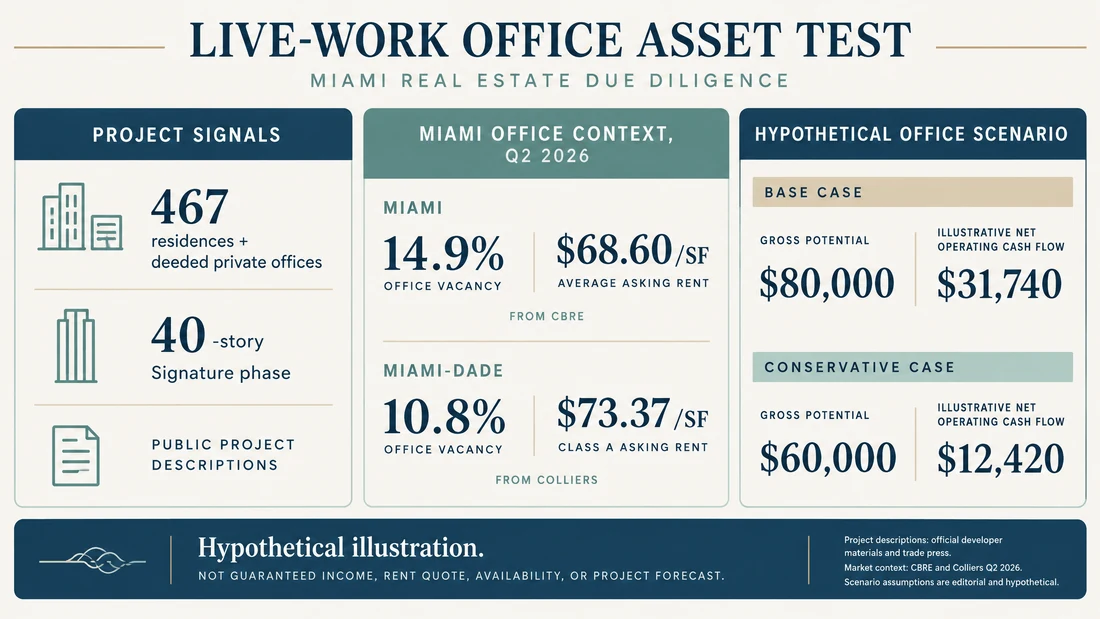
The infographic summarizes public project descriptions and reported market signals. The US$80,000 figure is commercial potential used in a hypothetical test; it is not guaranteed income.
How to decide whether the office is a real asset
The office passes an initial asset test only when five answers are supported by documents or market evidence:
- Legal separability: the title and declaration make the office a clearly defined, transferable interest.
- Operational freedom: the intended owner use and third-party lease use are expressly workable.
- Cost visibility: HOA, taxes, insurance, management, reserves, and special-assessment exposure are measurable.
- Demand evidence: rent and vacancy assumptions come from comparable, relevant offices rather than a headline number.
- Exit flexibility: there is a plausible buyer or tenant universe beyond the original condo sales channel.
If those answers are weak, the office may still be valuable as a private work environment. But its value should be modeled as a premium amenity with personal utility, not automatically as a separate investment asset. Personal utility can be rational for an owner-occupier; it simply should not be confused with rent-producing performance.
A practical decision sequence for international buyers
Start with the buyer’s actual use case: live in the residence and work in the office; live in Miami part-time and lease one or both assets when allowed; or acquire the package primarily for investment. Then ask the project team for the exact offering documents and an office-specific cost schedule. Have independent professionals review title, condominium documents, tax treatment, insurance, and the intended business use.
Only after that should the buyer request a rent opinion from a local commercial broker, run at least three vacancy scenarios, compare net cash flow with alternatives, and decide how much of the purchase price is being assigned to the office. An international buyer’s currency planning should also distinguish a dollar-denominated asset from a dollar-denominated profit: a property can be priced in dollars and still produce weak or irregular cash flow.
A consultative next step
If the live-work structure fits your Miami strategy, speak with Faccin Investments before treating the office as an investment thesis. The right conversation is not “How much can it make?” but “What is the office, legally and operationally, what does it cost to carry, who would rent it, and how would we exit?” Faccin can help organize the opportunity review around the buyer’s intended use, documentation, total cost, demand evidence, and downside scenarios — without replacing the independent legal, tax, insurance, title, or accounting reviews the transaction requires.
FAQ
Is the One Twenty Brickell private office automatically a separate investment?
No. Public materials describe deeded private office suites, but the buyer must confirm the exact legal description, title treatment, transfer rights, permitted use, and condominium documents for the specific unit. A separate deed is an important starting point, not proof of liquidity or income.
Can I rent the office to another professional?
Possibly, but this must be confirmed in the declaration, bylaws, rules, purchase documents, and applicable local requirements. Check tenant eligibility, approval, lease term, professional use, access, signage, hours, and any restrictions on client visits before using rent in an underwriting model.
Is US$80,000 per year guaranteed?
No. The figure is a commercial potential cited in market coverage and should be tested as a gross scenario only. Actual results depend on rent, vacancy, collection, costs, taxes, insurance, management, fit-out, tenant demand, and the office’s legal and physical characteristics.
Should the residence and office be analyzed together?
They should be coordinated but underwritten separately. The residence has a residential use and tenant market; the office has a professional-use profile, commercial competition, and potentially narrower liquidity. Combining their values can hide a weak office thesis.
What is the first document to request?
Request the complete offering package and the recorded condominium declaration, including the office’s legal description and exhibits, then reconcile those documents with the purchase agreement, budget, rules, title commitment, tax estimate, insurance requirements, and leasing policy.
Contact Faccin Investments to discuss the next step with Faccin Investments.