





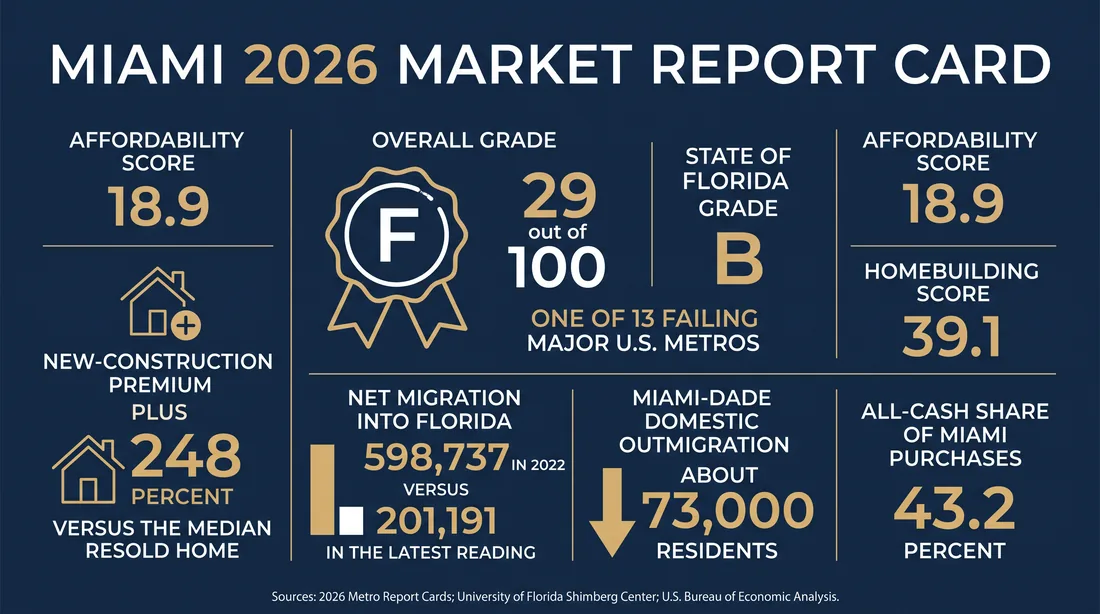
Miami’s 2026 report card is blunt: the metro earned a 29 out of 100, with affordability at 18.9 and homebuilding at 39.1. Miami is one of 13 major U.S. metros graded F, even as the state of Florida earned a B. Those grades reflect a market running two migration stories at once—wage-dependent residents struggling to buy or stay, and wealth-driven buyers continuing to arrive and transact—creating a split that affects how you shop, what you can negotiate, and how to structure your offer.
Your real competition in 2026: cash vs. financed
Nearly half of Miami buyers are not using a mortgage: 43.2 percent of 2026 purchases closed all-cash. That share reshapes day-to-day competition. Cash compresses timelines, removes financing and appraisal contingencies, and lowers the seller’s perceived execution risk. For financed buyers, the adjustment is not optional—you are often bidding against someone who can close in days.
To compete with cash, financed buyers typically lead with underwriting readiness, larger earnest money deposits, shorter inspection periods, and, when appropriate, appraisal gap coverage. Clean, well-sequenced contingencies and a clear path to close can matter more than marginal price changes in multiple-offer scenarios. In condo buildings with complex reviews or newly increased reserves, early lender engagement is essential because underwriting standards vary by building profile.
Expect more head-to-head with cash at the top of the market. Luxury transaction volume in South Florida set a new high in the first half of 2026, and high-end listings continue to see deep pools of equity-rich buyers. That said, cash also shows up in the middle of the market, especially from relocation buyers who sold in higher-cost metros or seasoned investors shifting portfolios.

Where negotiation still exists
Negotiation today is highly segment-specific. Sellers with assets facing cost friction—older condos with rising insurance and newly mandated reserves, or associations planning assessments—tend to be more price- and concession-aware. Thorough document review (budgets, reserves, engineering reports, insurance renewals) changes the negotiation posture because monthly cost visibility is now a primary decision factor for many buyers.
You can also see negotiation openings with functionally obsolete homes away from prime waterfront or far from new employment clusters, especially where timelines are seller-driven (estate sales, relocations). In new development, incentives tend to appear in the form of closing cost credits, rate buydown contributions via preferred lenders, or upgrade packages rather than headline price reductions, particularly where developers are protecting comp integrity. Those levers vary by submarket and delivery schedule.
Not every listing is flexible. Turnkey homes and new builds priced for a specific lifestyle segment—waterfront, branded residences, trophy views—often trade with fewer concessions if they are correctly priced relative to their peer set.
The two migration stories behind today’s demand
Domestic inbound to Florida has slowed from pandemic highs, and Miami-Dade—one of the state’s highest-cost counties—posted a net domestic outflow of nearly 73,000 residents last year. Wage-dependent households are feeling the squeeze from higher carrying costs, including insurance and condo fees, and are more likely to move within Florida or to lower-cost states when ownership math no longer works.
At the same time, wealth-driven demand continues. Even with a cooling in wage-based inflows and a notable drop in nonlocal online search interest from New York City this fall, high-end buyers are still transacting at record volume. The mix shift matters: fewer financed, median-income shoppers competing for the same homes, and more equity buyers concentrating in specific neighborhoods and price bands.
This split demand helps explain how sales can stay brisk at the top while affordability worsens in the middle.
What the 2026 market report card says about Miami
The 2026 grades quantify the gap. Miami’s overall 29/100 sits inside a state that earned a B, underscoring how local conditions can diverge from statewide narratives. Affordability at 18.9 reflects the math facing a median earner with an annual income around $74,274: nearly 47 percent of that income goes to the monthly payment on a median-priced home near $507,237. That burden leaves limited cushion for taxes, insurance, and association dues.
On the supply side, Miami leads the 100 largest metros in the new-construction premium. A typical new build here is priced about 248 percent above the median resale. That differential is structural, not temporary—land, construction, insurance, financing, and permitting costs push developers to deliver almost exclusively at higher price points. More new units do not automatically translate into broader affordability.
Living costs now sit 14.1 percent above the U.S. average—second highest among major U.S. cities—which is felt in everyday budgets but is not the primary driver of pricing at the top end.
The infographic below is in English and summarizes these numbers for quick reference.
Why a supply boom can coexist with an affordability problem
Miami can add cranes and still fail affordability because new inventory arrives where the economics pencil: luxury and upper-tier product. Rising hard costs, insurance premiums, and debt costs make entry-level or mid-market development broadly unviable. That means incremental supply often targets buyers with asset-derived or business income rather than wage-only households.
At the same time, operating costs in older buildings are escalating. Post-Surfside reforms require structural inspections and fully funded reserves for aging condos; pair that with higher insurance premiums and, in some cases, special assessments, and the monthly carry for units that used to serve middle-income buyers has moved higher. Resale price tags may look accessible, but all-in costs can change the picture.
The result is a barbell: robust activity at the top among all-cash or lightly leveraged buyers, and a thinner, more price-sensitive middle where financed offers face tighter monthly budget constraints.
Practical buying criteria in an F-graded metro inside a B state
- Define success by use-case, not headline price. For primary residences, prioritize monthly carry stability and insurability. For second homes, weigh travel patterns, rental restrictions, and building governance.
- Underwrite the building, not just the unit. For condos, evaluate reserves, insurance renewals, maintenance history, milestone reports, and planned capital projects. Budget for fee increases.
- Stress-test the monthly number. Account for principal and interest (if financing), taxes, insurance, and association dues. Use conservative assumptions on insurance and HOA trajectories.
- Prepare for cash competition. Pre-underwriting, proof of funds for down payment and reserves, and streamlined contingencies help narrow the execution gap.
- Expect micro-market differences. Waterfront, urban cores, and school-driven neighborhoods price and negotiate differently from inland or transition areas. Time on market and concession patterns vary by sub-neighborhood and product age.
- For new construction, look beyond base price. Delivery dates, deposit schedules, association budgets, and developer warranties affect total cost and risk tolerance.
Frequently asked questions
Can I still compete with cash if I need financing?
Yes, but execution matters. Secure full underwriting, keep contingencies targeted and short, show strong reserves, and be flexible on closing timelines. Price is not the only lever sellers value.
Where are negotiation pockets most common right now?
Older condos with rising fees or pending assessments, functionally obsolete properties, and certain inland submarkets show more flexibility. Trophy assets and well-priced new builds see fewer concessions.
How do post-Surfside rules affect buyers?
They improve transparency and long-term maintenance but raise monthly costs through higher reserves and insurance. Review association documents early to understand your true all-in carry.
Does Florida’s stronger state grade mean I should look outside Miami?
It can widen your options. Nearby metros may offer different affordability profiles and competition levels. The choice depends on your lifestyle needs, commute patterns, and price tolerance.
The bottom line for Miami housing market 2026 buyers
Miami is simultaneously shedding wage-dependent residents and attracting wealth-driven purchasers. That split underpins an F-graded metro inside a B-graded state, a 248 percent new-build premium over resales, and a median buyer who would spend nearly 47 percent of income on a median-priced home. If you’re buying now, accept the two-lane reality: compete deliberately against cash in segments where it dominates, and pursue negotiation where operating costs or functionality create leverage. Clarify your use-case, underwrite the building as closely as the unit, and align your offer structure with the execution standards of a cash-heavy market.
For tailored, property-level guidance in the Miami housing market 2026, and to translate these dynamics into an actionable search and offer plan, Contact Faccin Investments