







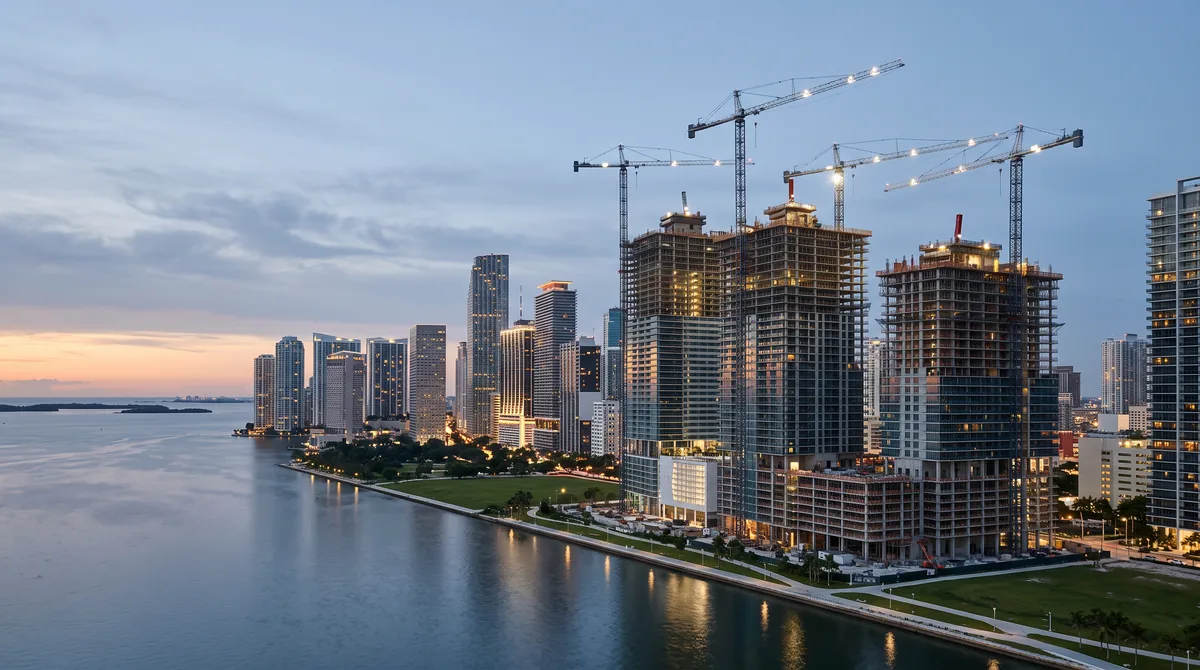
Buying pre-construction is a decision about a future home, not only a floor plan. The key question is whether the project can become a completed, permitted building on a timeline and at a cost the buyer can understand. Brickell concentrates a large share of Miami’s new supply, with strong Latin American demand. A current situation there teaches why delivery risk needs its own review. This is educational content, not legal, tax, or investment advice; every case depends on the contract and current facts.
The case involves a partially built, two-tower project with 791 units valued at more than US$2 billion when completed. A new construction lender filed a foreclosure lawsuit alleging that the borrower failed to repay a loan at its January 2025 maturity date; the developer countersued and disputes the lender’s conduct. A separate dispute between the developer and an investor includes allegations from both sides. Reports describe a possible rescue with a new development partner and financing above US$1 billion, including C-PACE, but it had not closed when reported.

These facts are not a prediction about the outcome. A building may be visibly rising while its financing, approvals, contractor relationships, or delivery schedule remain uncertain, and a lawsuit does not by itself establish that a buyer’s contract will fail. The buyer’s task is to verify facts affecting completion and understand how the contract allocates the consequences.
A separate event shows the operational side of risk. On September 14, 2026, a drill rig collapsed at a high-profile Brickell construction site, injuring four people. Work was paused and a county stop-work order was in place while the federal safety agency investigated. It illustrates schedule and site risk, not a financial conclusion about every Brickell project or the rights of buyers elsewhere.
Start with the developer, not the brochure
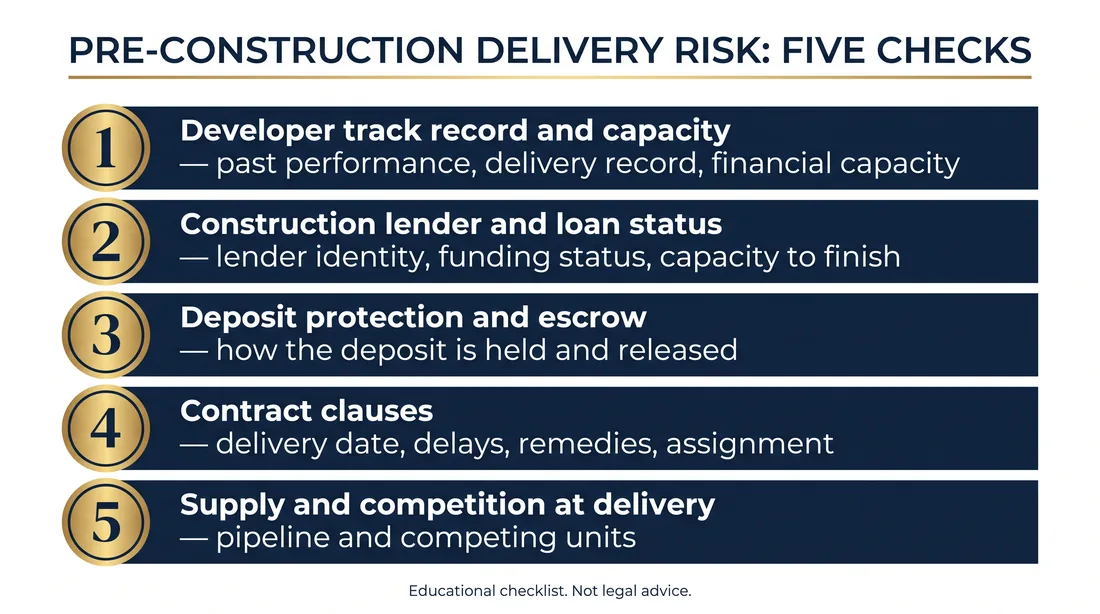
Review the incorporator’s completed projects, delivery history, construction partners, and experience with comparable scale. Ask whether prior timelines changed, how changes were communicated, and whether the contracting entity has meaningful assets or relies on a wider group. A polished sales history is not evidence of current capacity.
Financial capacity deserves its own file. Request the project budget, construction loan information, required equity, current construction status, and who funds cost overruns. Compare the planned funding inflows and outlays with the work remaining. The objective is not to forecast a return; it is to understand whether completion and closing obligations appear fundable under current facts.
Why the construction lender matters
The construction lender matters because a secured lender may have rights affecting project control, funding, and timing. Loan maturity is the date by which debt is scheduled to be repaid or resolved under the loan documents. Missing it can lead to negotiation, extension, restructuring, enforcement, or litigation. It does not automatically cancel a buyer’s contract or guarantee completion.
Ask whether the loan is current, extended, in default, subject to a reservation of rights, or being refinanced, and require documents rather than reassurance. Ask how deposits interact with the loan, whether the lender acknowledges purchaser protections, and what happens if control changes. The answer varies by contract, jurisdiction, escrow structure, and security documents.
Protecting the deposit and reading the contract
Deposits are typically governed by the purchase contract and escrow, but “in escrow” is not a substitute for reading the terms. Confirm who holds the funds, release conditions, permitted uses, notice process, and what happens if the transaction is terminated, delayed, or transferred. Check whether any portion can be released during construction and obtain written confirmation of each deposit.
Read the estimated delivery date, permitted delays, remedies, assignment rights, price-escalation language, and association estimates. An estimated date may allow defined extensions; a delay clause may cover matters beyond the seller’s control, subject to wording and notice. Remedies may be limited or unequal. Assignment can restrict resale or require consent. Price escalation can change the closing cost. Test association estimates against services, reserves, insurance, and possible extraordinary charges.
A useful comparison is:
| Situation | What it may mean | What the buyer should verify |
|---|---|---|
| Delayed | Work or delivery is later than the estimate | Revised schedule, contract extensions, notices, and funding for remaining work |
| Financially stressed | The project may face funding, cost, or liquidity pressure | Current budget, lender status, equity, unpaid obligations, and contingency plan |
| Formally in default | A contractual or loan obligation is alleged to have been breached | The relevant notice, cure period, enforcement step, and effect on the buyer’s contract |
These categories can overlap but are not interchangeable. A delay can arise from permitting or site conditions without formal default. A project can be financially stressed before a public lawsuit. A formal default can be disputed, cured, restructured, or resolved differently across contracts. A foreclosure case concerns financing parties; its effect on a purchaser depends on the documents and applicable law.
Why a discount is not a risk analysis
A launch discount is visible and immediate; delivery risk is harder to price because it may involve time, carrying costs, changed specifications, an association budget, or waiting while facts develop. If the discount does not compensate for unpriced risk, it is not necessarily a bargain. Compare the full commitment: deposit schedule, financing cost, closing expenses, taxes, association charges, and lost flexibility.
Documents and professional review
Request the purchase agreement and exhibits, escrow instructions, amendments, disclosure materials, construction updates, association budget or estimate, and written statements about lender or project status. Ask for the seller’s relevant entity chart, permits and approvals, and contractor information. Keep a dated record of representations rather than relying on a presentation that may change.
A Florida real estate attorney should review the contract and consequences of delay, default, foreclosure, assignment, and deposit release. A qualified accountant or tax professional should address the buyer’s position. A finance professional can examine funding assumptions and carrying capacity, while a construction professional assesses progress, remaining scope, and schedule logic. Their roles are different and none replaces the others.
FAQ: delivery risk in Miami pre-construction
Does a foreclosure lawsuit automatically cancel my purchase contract?
No. A foreclosure lawsuit is a financing dispute, and its effect on a purchase contract depends on the contract, escrow terms, notices, and applicable law. Obtain a case-specific review of the documents and current facts.
Is a partially built tower safer than a project that has not started?
Visible progress can reduce some construction uncertainty, but it does not answer whether funding, approvals, lender rights, or delivery obligations are secure. Progress is one data point, not a conclusion.
What should I ask about the loan maturity date?
Ask whether the debt was repaid, extended, refinanced, or alleged to be in default; whether enforcement has begun; and how any change in control could affect construction and purchaser protections.
Can escrow guarantee that I will receive the apartment?
Escrow can clarify custody and release conditions for deposits, but it is not a guarantee of completion. Read the escrow instructions together with the purchase contract.
A disciplined next step
Treat every Miami pre-construction purchase as a document-and-status review, not a prediction. Recheck the project’s current facts immediately before signing and before each significant payment, and have the appropriate professionals evaluate the contract, finance, tax, and construction questions. When you are ready to organize that review, Contact Faccin Investments.