



For international buyers, Miami airport infrastructure is more than a travel story. It is part of the location, timing and ownership analysis that should happen before choosing a neighborhood.
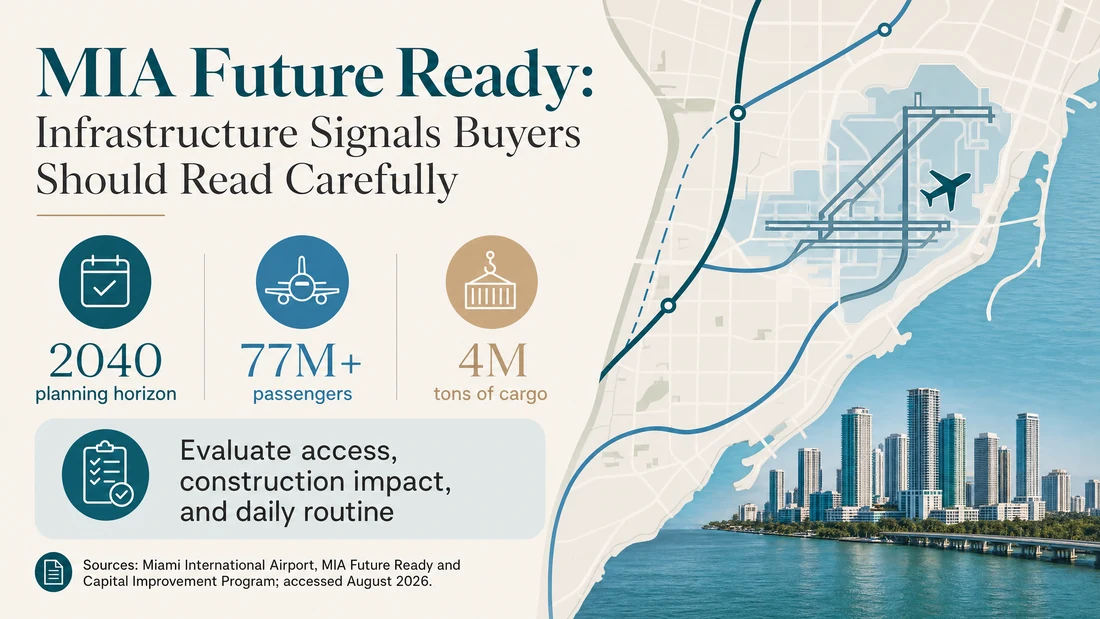
Miami International Airport is moving through a long-term modernization program known as MIA Future Ready. The official program covers improvements to passenger experience, terminal systems, circulation, security and capacity, while the airport’s capital-improvement materials describe projects involving concourses, gates, elevators, escalators, restrooms, parking and related infrastructure. The airport has also communicated a long-range objective of serving more than 77 million passengers and handling 4 million tons of cargo by 2040.[1] [2]
For a buyer comparing Miami with other global gateways, the important question is not whether an airport project will automatically increase property values. It will not. The useful question is how infrastructure changes the practical relationship between a home, a business schedule, a family and the international network that makes Miami attractive in the first place.
Connectivity is an ownership variable
International buyers often begin with a map of buildings and neighborhoods, but the map should also include the journeys that will happen after closing. A family that expects frequent travel, school visits, business meetings or regular guests may value a predictable route to the airport differently from a buyer whose property is designed for occasional personal use. The same distance can feel very different depending on traffic, flight timing, luggage, children and the number of trips made each year.
That is why airport access should be treated as one input among several: daily lifestyle, building quality, insurance, association costs, rental rules, schools, medical services and future resale audience. Connectivity can support the usefulness of a location, but it cannot compensate for a weak building or an unsuitable ownership structure.
What MIA Future Ready changes — and what it does not
The official program is a portfolio of projects, not one single construction event. Different works can affect different terminals, roads, passenger flows and time horizons. Miami Today has also reported that the airport has been acquiring nearby land as part of its broader expansion strategy.[3] These facts make the airport relevant to a buyer’s long-term research, but they do not justify treating every nearby property as a guaranteed beneficiary.
Infrastructure can create benefits and trade-offs at the same time. Better facilities may improve passenger capacity and resilience. Construction may temporarily change access, noise patterns or traffic. A location that looks convenient on a map may still be less comfortable for a family seeking quiet waterfront living. A disciplined analysis keeps both sides visible.
How international buyers should compare locations
A practical comparison starts with four questions. First, how long does the property actually take to reach the airport at the times the buyer will travel? Second, which route is used, and how exposed is it to recurring congestion or major works? Third, does the neighborhood offer the daily services the household needs without turning every errand into a drive? Fourth, will the same combination of access and lifestyle make sense to the next buyer if the property is sold later?
These questions are especially important for buyers who will not live in Miami full time. A second home needs reliable management, access, maintenance and security. A relocation property needs schools, healthcare, shopping and a daily routine. A rental-oriented purchase needs rules, tenant demand and building governance. Airport proximity is helpful in all three cases, but it solves a different problem in each one.
Construction requires a wider due-diligence lens
Buyers should review official project information, current access conditions and neighborhood-level observations rather than relying on a headline about billions of dollars or future capacity. Ask which terminal is affected, what phase is active, whether the project has a confirmed schedule and whether the property’s own association has documented any access, noise or insurance implications. These are practical questions, not predictions.
It is also important to separate public infrastructure from private development marketing. A new road, terminal or airport facility may improve the region’s operating capacity, but it does not guarantee that a specific condo will outperform. The purchase still depends on price, building condition, reserves, rental restrictions, insurance, taxes, maintenance and the buyer’s time horizon.
A better way to use Miami’s connectivity advantage
Miami’s global appeal comes from the combination of air access, culture, business, healthcare, schools, waterfront lifestyle and a broad housing market. MIA Future Ready reinforces the importance of that network, but it should be used as context inside a broader property decision. Buyers who study the airport together with neighborhoods, buildings and ownership costs can make a more resilient shortlist.
Faccin Investments helps international buyers compare Miami locations through the lens of use, access, building quality, due diligence and long-term strategy. If you are evaluating a home or investment in South Florida, contact Faccin Miami before selecting a building solely because it appears close to the airport.