




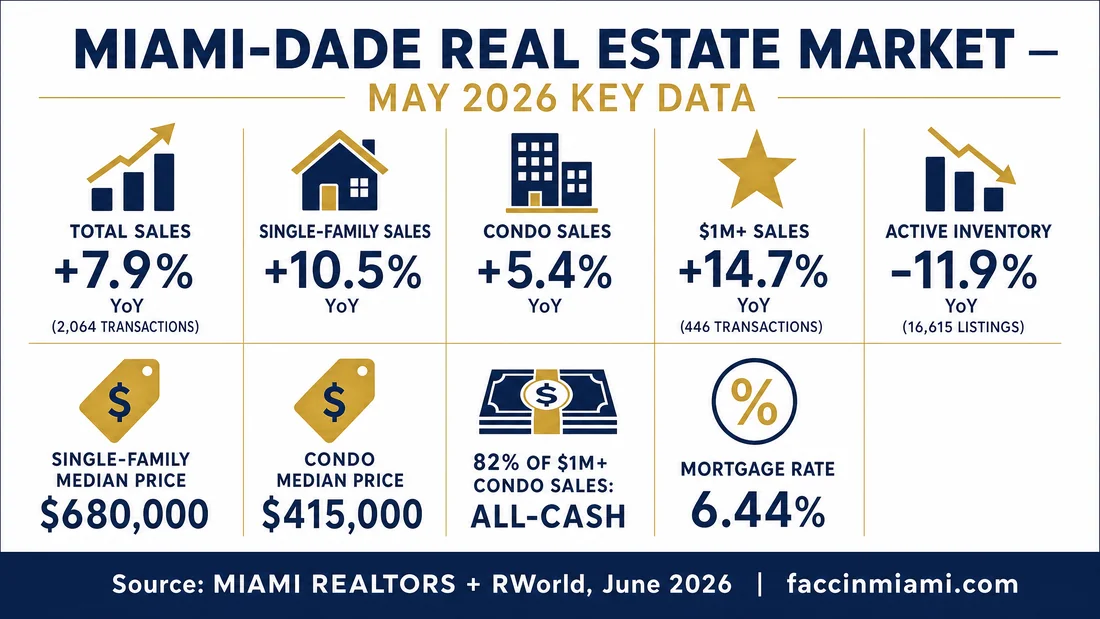
Miami-Dade County’s real estate market extended its winning streak in May 2026, with total home sales rising 7.9% year-over-year — the ninth consecutive month of annual sales growth. The data, released by the MIAMI Association of Realtors, confirms that the market’s resilience is not a short-term phenomenon but a structural trend driven by sustained international demand, limited inventory, and a luxury segment that continues to outperform.
Key Data Points: May 2026
The headline numbers tell a clear story. Total closed sales in Miami-Dade reached 2,847 transactions in May 2026, up from 2,638 in May 2025. The luxury segment — defined as properties priced at $1 million and above — was the strongest performer, with sales up 14.7% year-over-year. This outperformance reflects continued demand from high-net-worth domestic and international buyers who are less sensitive to mortgage rate fluctuations.
Inventory declined 11.9% year-over-year, with active listings falling to 14,203 from 16,122 in May 2025. The months of supply — a measure of how long it would take to sell all active listings at the current sales pace — dropped to 5.0 months for single-family homes and 6.2 months for condominiums. Both figures are below the 6-month threshold that typically defines a balanced market, confirming that Miami-Dade remains a seller’s market in most price segments.
Median prices showed moderate appreciation. The median sale price for single-family homes rose 4.2% year-over-year to $685,000, while the median condo price increased 2.8% to $425,000. The more modest condo appreciation reflects the ongoing adjustment in the mid-market condo segment, where higher HOA fees and insurance costs have dampened demand from first-time buyers and investors seeking short-term rentals.
What Is Driving the Market
Several structural factors continue to support Miami-Dade’s real estate market. International buyer activity remains elevated, with buyers from Brazil, Colombia, Argentina, and Canada accounting for a significant share of luxury transactions. The Miami Association of Realtors reports that international buyers represented approximately 18% of all closed sales in the first quarter of 2026, with the average international buyer spending $850,000 — significantly above the overall market median.
The mortgage rate environment remains a headwind for domestic buyers. The 30-year fixed rate averaged 6.7% in May 2026, according to Freddie Mac, which continues to price out a segment of first-time buyers and move-up buyers who need financing. However, the luxury segment is largely insulated from this dynamic, as cash transactions accounted for 42% of all Miami-Dade sales in May — well above the national average of approximately 28%.
The South Florida 2026-2027 Housing Outlook, published by the Miami Association of Realtors in June, projects that total sales will increase approximately 3% in 2026 compared to 2025, with price appreciation moderating to 2-4% annually. The report notes that mortgage rates are expected to decline gradually toward 6.2-6.5% by year-end, which could stimulate additional demand from rate-sensitive buyers in the second half of the year.
Implications for International Buyers
For international buyers evaluating Miami-Dade real estate, the May 2026 data reinforces several key conclusions. First, the luxury segment continues to offer the most favorable supply-demand dynamics, with inventory declining faster than the overall market and sales growth outpacing lower price points. Second, the cash-heavy transaction profile means that buyers who can transact without financing are at a significant competitive advantage, particularly in multiple-offer situations. Third, the inventory decline means that buyers who are waiting for a significant price correction are likely to be disappointed — the data does not support that scenario in the near term.
The condo market requires more nuanced analysis. While overall condo sales are growing, the mid-market segment (roughly $300,000 to $600,000) faces headwinds from rising HOA fees and insurance costs that have increased the true cost of ownership significantly over the past two years. Buyers in this segment should model total cost of ownership carefully, including HOA fees, insurance, and potential special assessments, before committing to a purchase.
Contact Faccin Investments for a personalized market analysis and to explore current opportunities in Miami-Dade that align with your investment objectives and timeline.
Frequently Asked Questions
Is Miami real estate still a good investment in 2026?
The May 2026 data supports continued investment in Miami’s luxury segment, with sales growing for the ninth consecutive month and inventory declining. The market remains fundamentally sound, driven by international demand and limited supply.
Are Miami condo prices dropping in 2026?
Condo prices are not dropping overall, but appreciation has moderated. The median condo price rose 2.8% year-over-year in May 2026. The mid-market segment faces more pressure from rising HOA fees and insurance costs.
How much cash do buyers need for Miami luxury real estate?
Cash transactions accounted for 42% of all Miami-Dade sales in May 2026. While financing is available, cash buyers have a significant competitive advantage in multiple-offer situations, particularly in the luxury segment.
What is the outlook for Miami real estate in the second half of 2026?
The Miami Association of Realtors projects 3% sales growth for full-year 2026, with price appreciation of 2-4%. Mortgage rates are expected to decline gradually toward 6.2-6.5% by year-end, which could stimulate additional demand.