







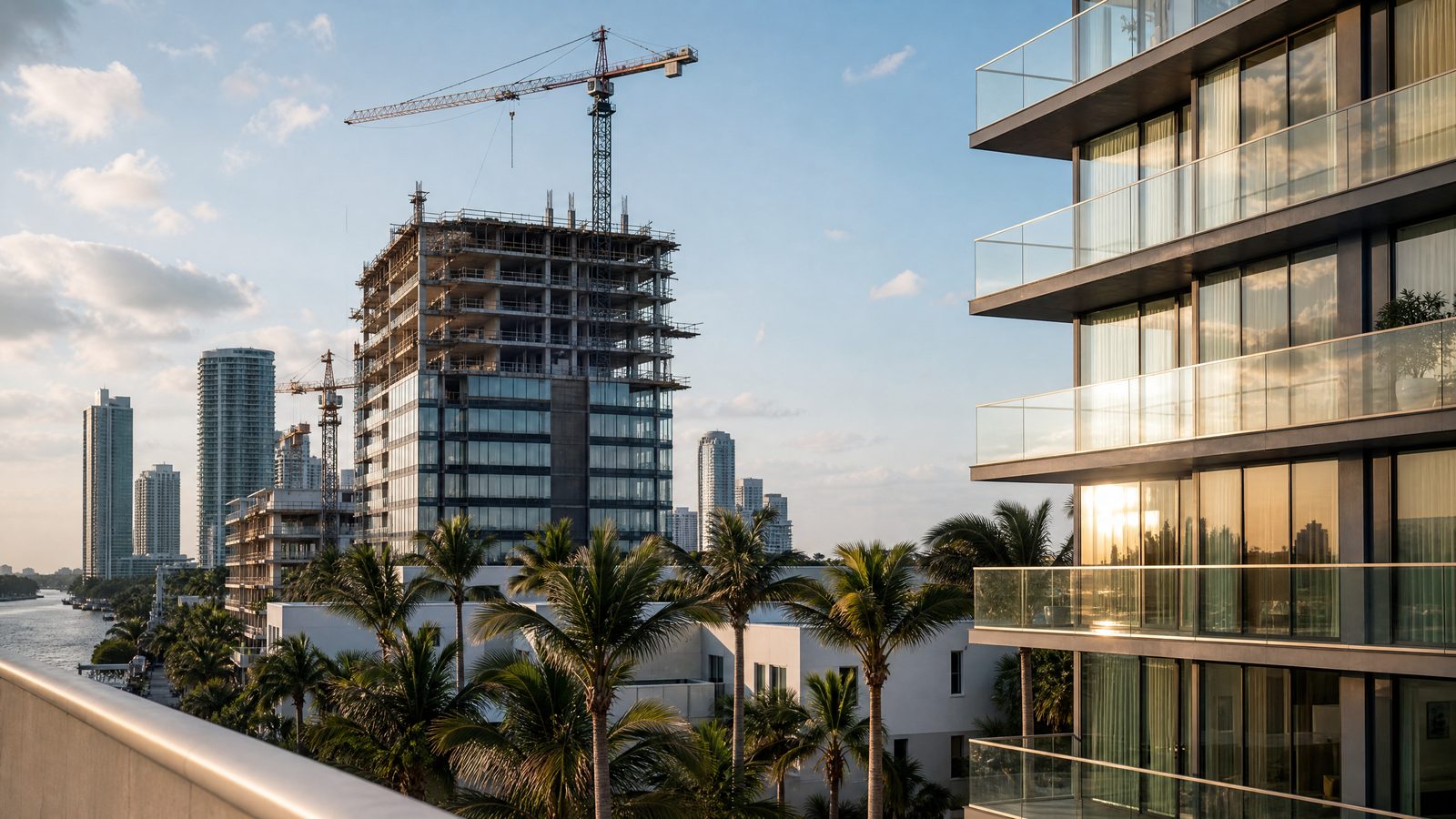
Pre-construction in South Florida keeps attracting Latin American capital, but the opportunity is no longer about buying early at any price. It is about understanding contracts, timing, deposits and the real strength behind each project.
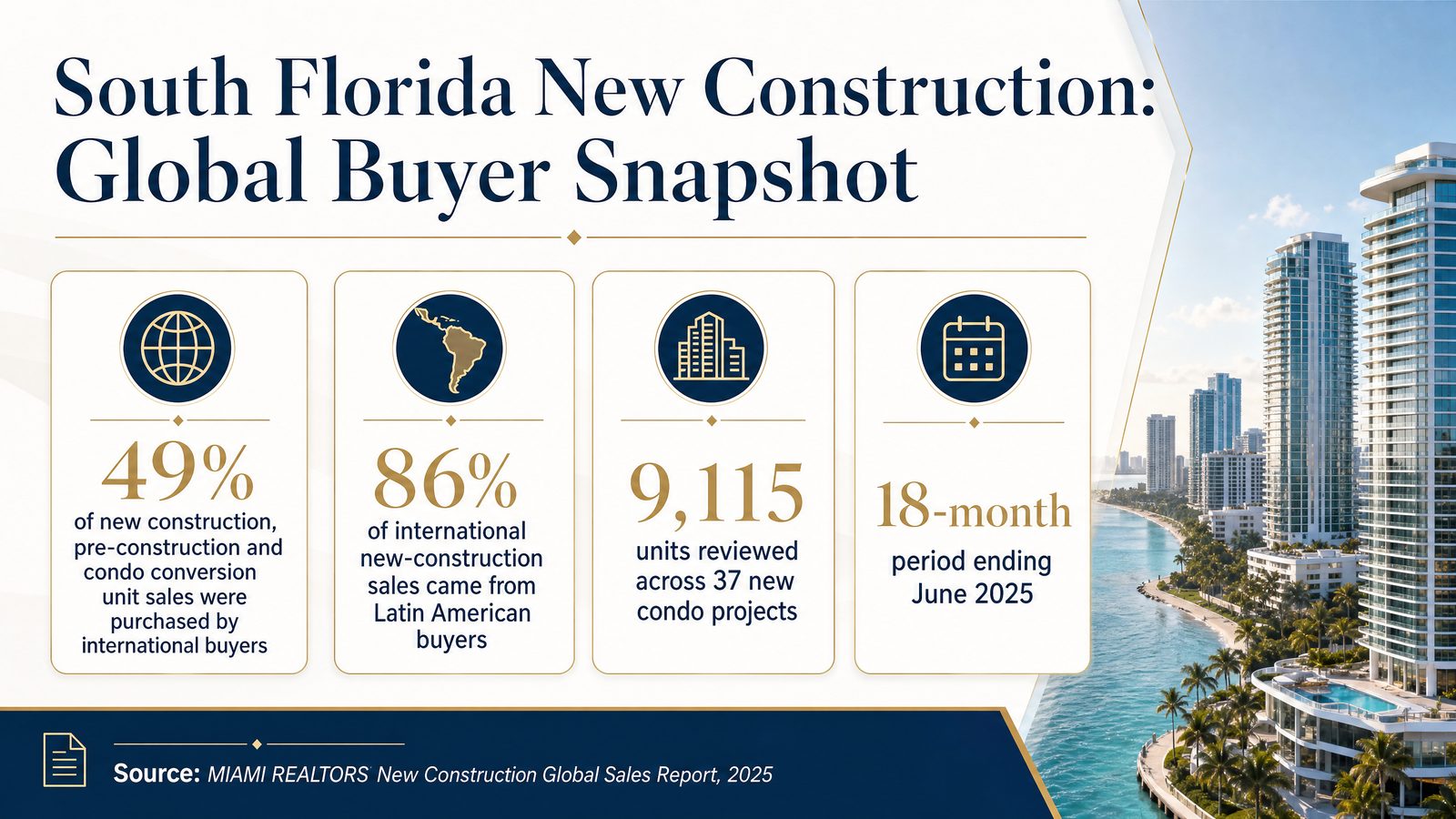
South Florida’s pre-construction market remains one of the clearest examples of how global capital continues to shape Miami real estate. A recent new-construction reading from MIAMI REALTORS reported that international buyers represented 49% of sampled new construction, pre-construction and condo conversion unit sales across 37 condominium projects. The same entity noted that Latin American buyers accounted for 86% of international sales in that segment.
Those figures help explain why developers continue to design, market and phase projects with the international buyer in mind. But for serious buyers, the headline is only the starting point. Pre-construction is not simply a way to enter a building before completion. It is a financial commitment spread over time, tied to developer execution, contract language, delivery risk, market cycles and the buyer’s ability to plan future dollar obligations.
Why Latin American buyers still like the segment
The appeal is understandable. New buildings offer modern design, updated systems, amenities built for current lifestyle expectations and the possibility of choosing a preferred line, view or floor before inventory becomes limited. For families planning a future move, a second home or a long-term U.S. base, the construction timeline can also be useful. It allows the buyer to organize capital gradually while the project moves toward completion.
For Latin American families, the segment often serves another purpose: it creates exposure to a dollar-denominated asset without requiring immediate occupancy. That can be attractive for buyers who want Miami in their future, but not necessarily in their daily routine today. The risk is assuming that every project with a strong sales gallery has the same fundamentals. It does not.

The contract matters as much as the view
In pre-construction, the contract is part of the asset. Buyers should understand the deposit schedule, cancellation rights, estimated delivery language, permitted changes, assignment rules, closing costs, association projections and rental restrictions. They should also evaluate the developer’s record, financing structure, construction progress, comparable finished product and the likely resale audience once the building is delivered.
The most common mistake is to compare only price per square foot and renderings. Those details matter, but they are not enough. A lower entry price can become expensive if the project has weak rental flexibility, uncertain timing or fees that were not properly anticipated. A premium project can make sense if it offers durable demand, strong governance and a location that will still be relevant after delivery.
How buyers should use the market data
The share of international and Latin American participation confirms that this is a global segment, not a purely local one. That depth can support pricing and absorption, especially in well-located projects. But market depth should not replace due diligence. It should raise the standard of analysis. If many global buyers are competing for the same product, the investor needs to know exactly why a specific unit deserves attention.
Faccin’s advisory lens is to connect each project to the buyer’s real objective. A unit intended for family use is different from a unit selected for rental flexibility. A future relocation plan is different from a capital preservation strategy. A buyer seeking prestige may accept different trade-offs than a buyer focused on exit liquidity. In pre-construction, the best decision is rarely the most emotional one. It is the one that still makes sense when the building is delivered and the market has moved on to the next launch.
What stronger research changes in pre-construction
Additional market context from Florida Realtors shows why international buyers continue to look at Florida as more than a lifestyle destination. For many families, the state offers a mix of personal use, tax planning conversations, dollar exposure, education access and long-term mobility. Pre-construction fits that mindset because it gives buyers time. But time can be an advantage only when the buyer uses it to understand the project, not simply to wait for delivery.
The best pre-construction analysis usually separates three decisions that are often blended together. First, is the location likely to remain desirable when the building is delivered? Second, is the developer capable of executing the product promised in the sales process? Third, does the specific unit make sense within the buyer’s plan for use, rental, resale or family transition? When those three answers do not line up, a beautiful project can still become an uncomfortable purchase.
Faccin readers can connect this topic with our previous look at most promising pre-construction developments in Miami and the broader discussion of Miami luxury condo pricing context. Those internal references help place a single launch within the larger Miami cycle instead of treating every sales gallery as a standalone opportunity.
Deposit discipline is part of the investment
Pre-construction buyers should also pay attention to how deposits interact with currency, liquidity and timing. A deposit schedule that looks manageable in dollars can feel different for a family whose income or business assets are mostly outside the United States. Exchange-rate movement, capital transfer timing and future closing obligations can change the real experience of the purchase. That is why buyers should not evaluate only the headline price. They should evaluate when money leaves their account, what flexibility they retain and what happens if family plans change before completion.
Another point is resale realism. Some buyers assume that buying early automatically creates a spread before delivery. Sometimes it can. But that outcome depends on absorption, comparable launches, developer pricing, contract assignment rules, building desirability and the condition of the broader market when the unit is ready. In a more sophisticated cycle, pre-construction is less about being first and more about being precise.
Speak with Faccin before reserving a pre-construction unit
A pre-construction reservation can move quickly, but the decision should not be rushed. Faccin Investments helps buyers compare launches, read the practical implications of deposit schedules, evaluate building fundamentals and connect the purchase to a broader Miami strategy. If you are considering a new development in South Florida, use the early stage to ask better questions before the contract defines your options. Contact Faccin Miami to review your pre-construction strategy with an advisory team focused on international buyers.